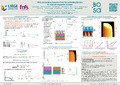
[en] Midbrain dopamine neurons exhibit slow and regular pacemaking supporting tonic dopamine release that is essential for motor and cognitive functions. The biophysical origin of this slow rhythmicity remains debated. To sustain such slow frequency of firing, a small
amplitude current is needed during the interspike interval. It could originate from either
cooperative ion channels or very small conductance pores. Recent work showed that the
pacemaker current does not result from cooperative channels, but from a newly identified small conductance pore sensitive to the gating-pore blocker 1-(2,4-xylyl)guanidinium (Jehasse et al, 2021). This conductance is considered as a pacemaker conductance (gpace) as it is active during the interspike interval and its blockade silences the spontaneous activity of midbrain dopamine neurons. However, its molecular identity and kinetics remains to be determined. We modeled this conductance from the voltage clamp data of Jehasse et al. and included it in a conductance-based model of dopamine neurons (Yu & Canavier, 2015) to investigate its biophysical properties. We first adjusted activation kinetics of sodium and calcium conductances to physiological values and observed that, without gpace, the model was not able to generate spontaneous activity nor slow frequency firing. Moreover, gpace restored slow pacemaking over a wider parameter space, even when conventional mechanisms failed. Our simulations reveal that only transient sodium, delayed rectifier potassium channels and gpace are required to produce slow pacemaking. Our findings suggest that slow-frequency firing requires the activation kinetics to be extremely fast. We also explored the role of other currents (e.g., A-type, H, and SK) and observed that they mainly enhance robustness to synaptic noise by reducing spike time variability, as observed before experimentally (Higgs et al., 2023). This mechanism, based on fast activation driving slow rhythmicity, contrasts with previous theories emphasizing slow-inactivating conductances (Bean, 2024). Our work introduces a minimal and robust framework for an alternative mechanism of slow pacemaking and lays the groundwork for dynamic clamp experiments and molecular identification of this novel current.
Bean, B. P. (2024). The Journal of Physiology.
Higgs, M. et al. (2023). eNeuro, 10
Jehasse, K., et al. (2021). Neuropharmacology, 197, 108722.
Yu, N., & Canavier, C. C. (2015). The Journal of Mathematical Neuroscience (JMN), 5, 1-19.