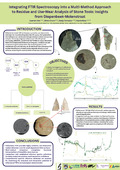
Integrating FTIR Spectroscopy into a Multi-Method Approach to Residue and Use-Wear Analysis of Stone Tools: Insights from Diepenbeek-Molenstraat - 2025
Archaeology; Spectroscopy; Adhesives; Use-wear; Residue; Stone tools
Abstract :
[en] This project explores the integration of Fourier Transform Infrared (FTIR) spectroscopy into a holistic framework for residue and use-wear analysis on lithic artifacts, using material from the Early to Middle Mesolithic open-air site of Diepenbeek-Molenstraat (Belgium) as a case study. While FTIR offers unique advantages in identifying organic and inorganic residues such as adhesives, plant and animal deposits, and mineral contaminants, its interpretative power is amplified when positioned alongside more traditional approaches, including optical microscopy. We present preliminary results from a controlled analytical workflow in which FTIR spectra from potential residue-bearing tools were contextualized through use-wear and residue analysis performed through optical microscopy and Scanning Electron Microscopy (SEM). Emphasis is placed on the capacity of FTIR to detect and characterize complex residue mixtures and taphonomic overprints, such as sedimentary films and environmental contaminants, that may obscure signals from functional residues. The Diepenbeek-Molenstraat assemblage, with its exceptional preservation and varied tool types, provides an ideal test case for evaluating FTIR’s role in reconstructing behavioural traces. By comparing in situ archaeological residues with spectra of known materials such as plant resins, vegetal fibers, animal fats, and minerals, this study highlights the strengths and limitations of FTIR as a complementary tool in lithic functional analysis. Ultimately, we advocate for a tightly integrated approach that anchors spectroscopic data within a wider interpretive framework, reinforcing the value of FTIR not as a stand-alone technique, but as a critical component of a multi-method analytical strategy.
Disciplines :
Archaeology
Author, co-author :
Lien, Lauren ; Université de Liège - ULiège > Unités de recherche interfacultaires > Art, Archéologie et Patrimoine (AAP) ; Université de Liège - ULiège > Département des sciences historiques > TraceoLab
Cnuts, Dries ; Université de Liège - ULiège > Unités de recherche interfacultaires > Art, Archéologie et Patrimoine (AAP) ; Université de Liège - ULiège > Département des sciences historiques > TraceoLab
Tomasso, Sonja ; Université de Liège - ULiège > Unités de recherche interfacultaires > Art, Archéologie et Patrimoine (AAP) ; Université de Liège - ULiège > Département des sciences historiques > TraceoLab
Rots, Veerle ; Université de Liège - ULiège > Département des sciences historiques ; Université de Liège - ULiège > Unités de recherche interfacultaires > Art, Archéologie et Patrimoine (AAP) ; Université de Liège - ULiège > Département des sciences historiques > TraceoLab
Language :
English
Title :
Integrating FTIR Spectroscopy into a Multi-Method Approach to Residue and Use-Wear Analysis of Stone Tools: Insights from Diepenbeek-Molenstraat