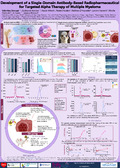
[en] Multiple myeloma (MM) is a blood cancer caused by malignant plasma cells in the bone marrow. It still remains incurable to this day to relapse from residual cells. Single-domain antibodies (sdAbs) properties combined with the precise cytotoxicity of Targeted alpha therapy (TAT)(1), a type of radioligand therapy, offer a promising approach for MM treatment. Our lab developed sdAb#2F8(2), which targets CD38, a glycoprotein overexpressed in MM(3). This sdAb can be radiolabeled creating an effective theranostic agent. It was efficiently produced using E. coli or Bacillus subtilis and then purified. The sdAb#2F8 has been previously characterized, demonstrating its diagnostic potential(2). For therapeutic purposes, it was conjugated with p-SCN-Bn-DOTA, obtaining in an average o1.8 DOTA molecules per sdAb, and labeled with the alpha-emitter 225Ac. Radiochemical purity (RCP) was assessed using radio-iTLC and radio-SEC, while stability over time was evaluated by incubation at 37°C in human serum. Labeling with 100 kBq 225Ac achieved RCPs of over 97% after 30 minutes of incubation. The radiolabeled sdAb maintained stability in human serum with RCPs above 90% after 24 hours, validating the use for the in vivo. Binding and internalization in CD38⁺-RPMI tumor cells were quantified by γ-counting, with parallel blocking experiments performed using non-radiolabeled sdAb#2F8 for comparative analysis. CD38 binding affinity was preserved, though internalization was limited. So, sdAb#2F8 can be labeled with ²²⁵Ac while keeping its CD38 binding. This is the first CD38-targeting sdAb labeled with ²²⁵Ac for TAT in blood cancers. Preclinical studies are planned to assess the benefits of TAT.
Marcion, Guillaume ; Université de Liège - ULiège > Département des sciences biomédicales et précliniques > Méthodes expérimentales des animaux de laboratoire et éthique en expérimentation animale
Withofs, Nadia ; Université de Liège - ULiège > GIGA > GIGA Platforms - In Vivo Imaging - Nuclear Medicine Division
Hustinx, Roland ; Université de Liège - ULiège > Département des sciences cliniques > Médecine nucléaire