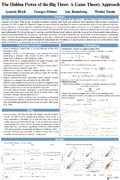
[en] This paper explores the growing influence of passive institutional investors, particularly the "Big Three"
—BlackRock, Vanguard, and State Street—on
corporate governance. With the rise of passive investment strategies, these funds now collectively hold significant stakes in major corporations,
including over 20% of S&P 500 companies. Despite extensive discussions regarding the collective and individual power of large passive funds, their
actual influence has not been properly established. Existing measures fail to accurately capture their power due to complexities like cross-ownership
and the dispersion of shareholders in countries such as the USA and the UK, where investors can wield more influence with fewer shares or become
more indispensable. We address this gap by applying a modified Banzhaf power index to assess the voting power of these passive funds, offering a
more nuanced measurement that accounts for voting rights structures. Our analysis shows that the voting power of passive investors is considerably
higher than their shareholding percentages suggest, as they play a critical role in forming coalitions during key corporate governance events. Results
further reveal that simpler power indices systematically underestimate the true influence of passive investors, underscoring the need for network-based
models like Z-index to capture their pivotal role in modern corporate control.
Disciplines :
Finance
Author, co-author :
Block, Aymeric ; Université de Liège - ULiège > HEC Liège Research > HEC Liège Research: Financial Management for the Future
Hübner, Georges ; Université de Liège - ULiège > Centres généraux > Centre interf. de recherche en gestion des bioindustries
Torsin, Wouter ; Université de Liège - ULiège > HEC Liège : UER > UER Finance, Comptabilité et Droit : Financial Reporting and Audit