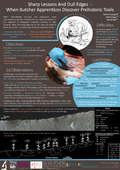
[en] Animal resources played an important role in Neanderthal food economy as testified by bone remains found at archaeological sites. While bone preservation is variable, stone tools are omnipresent and the wear traces they carry hold potential for tracking technical gestures, also those that leave no marks on bones. We present the results of a project in participatory science that involved the butchering of animals with experimental flint tools in collaboration with butcher apprentices and instructors from the municipal School of Hospitality and Tourism in Liège. In contrast to more traditional use-wear experiments that are regularly conducted by individuals with little experience in technical gestures, the goal of this initiative was to actively engage with modern-day butchers, to perform the butchery tasks with experienced technical gestures and to properly document these gestures for future reference. In addition, all use-wear evidence on the experimental stone tools was documented to generate archaeologically relevant and functionally meaningful reference data.
This pilot experiment resulted in a rich exchange between use-wear analysts and specialised artisans. In addition, a number of important observations could be made, such as the high number of experimental tools that were required to perform the tasks, which raises important questions about stone tool efficiency, use duration and the bias induced by archaeologists-performed experiments. The complexity in use-wear formation on tools with a long use duration next faced logistical limitations afterward.
Disciplines :
Archaeology
Author, co-author :
Escarguel, Solène ; Université de Liège - ULiège > Département des sciences historiques > TraceoLab
Coppe, Justin ; Université de Liège - ULiège > Département des sciences historiques > TraceoLab
Rots, Veerle ; Université de Liège - ULiège > Département des sciences historiques > TraceoLab
Language :
English
Title :
Sharp Lessons and Dull Edges - When Butcher Apprentices Discover Prehistoric Tools