face recognition; cost-efficiency; face learning; appearance; stability; within-person variability
Abstract :
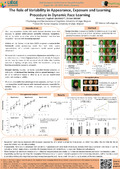
[en] Past research shows that people can recognise familiar faces readily but struggle to learn new faces. Recent lab-based studies argue that exposure to high variability learning conditions (i.e., changes in appearance and viewing conditions) facilitate the learning of new faces. However, recent data using famous actors found that in the real world, stability in appearance supports recognition in early stages of learning. However, at later learning stages, exposure to more variability in appearance seems to improve recognition. To reconcile these findings, we propose a dynamic and cost-efficiency face learning mechanism that follows a coarse-to-fine encoding. We hypothesize that exposure to stable facial information would quickly yield coarse and efficient representations, while exposure to increased variations would encourage a more costly encoding of finer diagnostic details.
We tested these hypotheses through five experiments using a strictly controlled but ecological video database. A total of 922 participants learnt four woman’s faces, with two in a stable appearance condition and the other two in a variable one. There were four learning groups, exposed to 3, 6, 9, or 12 videos per identity. Individual identities were learnt across spread learning episodes (3 videos each; Experiments 1, 2 and 5) or via single grouped learning blocks (Experiments 3 and 4). The similarity between test images and learning materials also varied across experiments. In all experiments but two, recognition improved with exposure. We also found that faces that were more similar to the learning materials in the stable condition were recognised better than those learnt under variable condition, in both spread and grouped learning. These findings help to bridge real-world and lab-based face learning research, refining our understanding of how humans may encode unfamiliar facial information efficiently.
Disciplines :
Theoretical & cognitive psychology
Author, co-author :
Li, Wenrui ; University of Liège - ULiège > Faculty of Psychology, Speech Therapy and Educational Sciences > Training. doct. scienc. Psych. ; Université de Liège - ULiège > Département de Psychologie > Psychologie et neurosciences cognitives
Legrand, Raphaël ; University of Liège - ULiège > GIGA > GIGA Neurosciences - Aging & Memory ; University of Liège - ULiège > Department of Psychology
Devue, Christel ; Université de Liège - ULiège > Département de Psychologie > Psychologie et neurosciences cognitives ; Université de Liège - ULiège > Psychologie et Neuroscience Cognitives (PsyNCog)
Language :
English
Title :
The role of variability in appearance and encounter condition in dynamic face learning