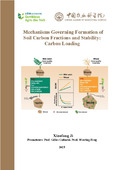
Abstract :
[en] Understanding the stabilization mechanisms of different fractions of soil organic carbon (SOC) pools is essential for predicting SOC persistence and informing sustainable agricultural practices. However, the formation pathways of particulate organic carbon (POC), aggregate-associated organic carbon (Agg-C), and mineral-associated organic carbon (MAOC) differ significantly, and the factors driving their stabilization remain unclear. In addition, existing indicators of SOC persistence—such as Δ¹⁴C, thermal stability, and microbial decomposition—are often expensive, time-consuming, and labor-intensive, limiting their applicability in large-scale or long-term studies. Therefore, there is an urgent need to clarify how management of crop residues such as straw regulate the formation and stability of different SOC pools and to identify practical, integrative indicators of SOC persistence. In this thesis, two laboratory incubation experiments with a long-term field sampling campaign across cropland soils explored how straw size, quality, and input levels affect the formation and stabilization of SOC pools. The potential of C loading (i.e., the ratio of SOC to mineral specific surface area) as a simplified and robust indicator of SOC persistence was also evaluated.
An 80-day incubation was conducted with wheat straw of two sizes (1-2 mm vs. <0.25 mm) added to artificial soils of two textures (3% and 7% clay). Small straw significantly enhanced both litter decomposition and the relative quantity of C stabilized in aggregates compared to large straw, regardless of soil texture. This enhancement was attributed to increased enzyme activity and dissolved organic C (DOC) production, which promoted macroaggregate formation over time. Furthermore, macroaggregate-associated C correlated with DOM aromaticity, while microaggregate-associated C was driven by DOC concentration. These results demonstrate that straw size regulates Agg-C formation through altering the quantity and quality of DOC during decomposition.
To investigate MAOC dynamics, I incubated low-quality wheat and high-quality milk vetch straw in artificial soils (with or without reactive minerals) for 420 days at seven input levels (0-35 g C kg⁻¹). Contrary to the Microbial Efficiency-Matrix Stabilization (MEMS) theory, low-quality wheat straw promoted greater MAOC formation than high-quality milk vetch. However, the MAOC stabilization efficiency declined at high input levels. Reactive minerals preferentially protected low-quality litter through direct interactions with plant-derived compounds, as indicated by lower C/N value and higher fluorescence index of DOM. These findings highlight a distinct plant-derived pathway of MAOC formation that is not solely dependent on microbial transformation, emphasizing the stabilization potential of low-quality straw under mineral-rich conditions.
In Chinese croplands with long-term fertilization, I analyzed the relationship between C loading and SOC persistence indicators including Δ¹⁴C and thermal stability (TG-T₅₀). The results show that C loading was significantly and negatively correlated with both SOC stability (increased Δ¹⁴C and dcreased TG-T₅₀) across sites, suggesting that it effectively reflects the strength of organic C-mineral associations and SOC stability. Given its simplicity, C loading may serve as a practical indicator for evaluating SOC persistence across diverse cropland systems.
Overall, the results reveal that different straw management strategies (in terms of size, quality, and input rate) distinctly affect the formation of SOC fractions via physical and chemical pathways. Moreover, I propose C loading as a cost-effective and integrative proxy for SOC persistence, offering new insight into SOC stabilization mechanisms and evaluation. Together, these findings contribute to the mechanistic understanding of SOC dynamics and provide a scientific basis for optimizing straw return practices to enhance long-term soil C storage in croplands.
Institution :
Xiaofang Ji [TERRA Research Centre, Gembloux Agro-Bio Tech, University of Liege], gembloux, Belgium