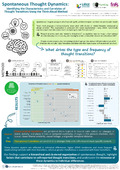
[en] The human mind continuously generates spontaneous thoughts (STs) that move fluidly from one topic to another. Although this dynamic is a key feature of STs, it remains understudied. Research suggests that STs follow a structured pattern in which clusters of related thoughts are interspersed with abrupt topic shifts. However, the characteristics of these transitions and their links to individual differences in STs are not well understood. To investigate this question, 44 undergraduate students verbalized their STs for 5 minutes using the Think-Aloud method. Then, they segmented their thought transcript into coarse- and fine-grained units, and rated thought transitions on dimensions such as topic change, and affective shifts. Participants also completed personality and psychological well-being questionnaires. Results showed that fine-grained transitions were more interconnected, while coarse-grained ones involved greater content and emotional shifts. Higher ADHD scores and frequent daydreaming were associated with more transitions, while mindfulness correlated with fewer transitions. These findings support a hierarchical organization of ST transitions, with implications for mental well-being.
Research Center/Unit :
PsyNCog - Psychologie et Neuroscience Cognitives - ULiège
Disciplines :
Neurosciences & behavior
Author, co-author :
Gilles, Arya ; Université de Liège - ULiège > Psychologie et Neuroscience Cognitives (PsyNCog)
D'Argembeau, Arnaud ; Université de Liège - ULiège > Département de Psychologie ; Université de Liège - ULiège > Psychologie et Neuroscience Cognitives (PsyNCog) ; F.R.S.-FNRS - Fonds de la Recherche Scientifique
Stawarczyk, David ; Université de Liège - ULiège > Département de Psychologie ; Université de Liège - ULiège > Psychologie et Neuroscience Cognitives (PsyNCog) ; F.R.S.-FNRS - Fonds de la Recherche Scientifique
Language :
English
Title :
Spontaneous Thought Dynamics: Identifying the Characteristics and Correlates of Thought Transitions Using the Think-Aloud Method