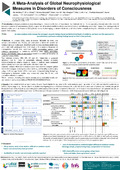
Abstract :
[en] Introduction: A known problem in neurophysiological research is the lack of reproducibility (Poldrack 2017). This is especially relevant when the research concerns disorders of consciousness (DoC), a spectrum of medical conditions where awareness is impaired following severe brain injury. The heterogeneity of clinical profiles and brain lesions in DoC patients makes it challenging to obtain reliable data, which is further complicated by the relatively small cohorts often used in DoC studies. As meta-analyses rank among the strongest research designs based on hierarchical levels of evidence, we here use this approach to quantitatively synthesise existing findings based on EEG, MEG and fNIRS in DoC patients.
Methods: In January 2022, using databases MEDLINE via Ovid, and Scopus and Embase via Elsevier, we conducted a literature search for resting-state EEG, MEG, and fNIRS studies published from 2000 to 2022, involving adults (≥16 years old) with prolonged DoC (≥28 days) and a primary diagnosis of unresponsive wakefulness syndrome (UWS; presenting arousal and reflexive movements) or minimally conscious state (MCS; presenting arousal and minimal signs of awareness), based on a validated behavioural scale (Schnakers 2020). Two referees (among MM, ZW, SA and JA) independently screened abstracts and full texts of potentially relevant studies, followed by extraction of useful statistics. Authors were contacted when statistics were not available in the published materials. Separate random effect meta-analyses were conducted to compare global metrics between UWS and MCS, and healthy controls (HC) using the R package 'meta'. Effect sizes were computed using Hedges' g; heterogeneity between studies was measured using the Q test and quantified with the I2 statistic. The full protocol, including the search strategy using controlled vocabulary and keyword terms, is available on PROSPERO (CRD42022327151).
Results: As of January 2023, from a total of 3563 unique studies, 21 were found eligible for inclusion in the meta-analysis, spanning a total of 499 UWS and 508 MCS patients, as well as 240 HC (Figure 1). We here report only measures appearing in three or more studies. This included EEG studies investigating differences between HC, UWS and MCS in measures of power (relative power), connectivity (debiased weighted phase lag index) and graph theory (clustering coefficient, variability of the participation coefficient) for δ (0.5-4Hz), θ (4-8Hz), α (8-13Hz), β (13-30Hz) and γ (>30Hz) bands. For all comparisons, significant differences were found across multiple frequency bands for power, connectivity, and participation coefficient. Large effects were only found between HC and DoC (both UWS and MCS). Power and connectivity in δ and α bands consistently differed between HC and DoC (power: gUWS=3.42 (δ), 3.12 (α); gMCS=2.45 (δ), 2.77 (α); connectivity: gUWS=0.82 (δ), 1.60 (α); gMCS=0.74 (δ), 0.95 (α)), along with power in the β band (gUWS=0.93, gMCS=0.95). Still, heterogeneity between studies was often considerable and larger for UWS than MCS when compared to HC.
Power in δ and α bands, as connectivity in α band also differed between UWS and MCS, with medium effect sizes (Figure 2). Furthermore, UWS and MCS showed different power and participation coefficient in θ and connectivity in β band, all with small effect sizes.
Conclusions: Despite heterogeneity, we found major differences in EEG δ and α measures between DoC patients and HC; albeit the effect was smaller, δ and α measures consistently differed also between UWS and MCS, possibly indicating that these measures might be of interest for diagnostic purposes. The relatively larger variability observed in UWS compared to MCS studies supports the notion of heterogeneity of the former group, with part of UWS patients likely presenting covert awareness, i.e. behaviourally unresponsive but with residual brain activity similar to MCS (Thibaut 2021).