Abstract :
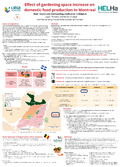
[en] Urban agriculture (UA) has successfully established itself, especially in cities of industrialised countries, despite the constraints limiting its development, including limited space for gardening. Domestic food gardening, practiced by households to meet their own needs, is a long-established practice in Montréal, at home and in community or collective gardens. However, despite UA’s popularity, political, financial and legal supports for such activities are limited. This poster presents recent estimations of the production of domestic gardening in the Montreal metropolitan area and evaluate the effect of an increase in gardening spaces in the city on food production.
According to a random survey disseminated in 2019 across five areas of metropolitan Montréal, gardeners’ representation among the population and food self provisioning in fresh fruits and vegetables were estimated. Thanks to an innovative method, these data have been extrapolated at broader scale such as the studied territories and the Montreal metropolitan area.
In 2019, those who garden produce in aggregate 14,837 metric tons of fresh fruits and vegetables in 183 hectares in Montreal city. Our model reveals that increasing gardening space could increase production to reach 24,384 t per year in 397 ha if gardens of less than 10 square meters were expanded to 15 square meters (scenario 2a). Food production could even double to reach 30,499 t produced in 674 ha if people lacking collective gardening spaces accede to 15 square meters plots (scenario 2b).
Domestic gardening food production is generally underestimated in industrialized countries’ cities. However, these activities occupy relatively restraints areas. According to city dwellers’ will, implementing new gardening spaces on roofs or in earth would strengthen domestic food gardening potential.
Moreover, this poster also enlarges the discussion in presenting preliminary results of a survey about domestic gardening conducted in the municipalities of Arlon, Attert and Messancy (Belgium) in 2025. Indeed, according to a collaboration between the GAL Arelerland and the Arlon Campus Environnement of the University of Liège, the here above methodology is being replicated. Thanks to few refinements, we attempt to link domestic gardening data and food potential estimation to nutrition and health epidemiological study. As a first attempt, we will present this Belgian study preliminary results and few challenges to improve our methodology.