children, field test, endurance, aerobic, intermittent, storytelling
Abstract :
[en] INTRODUCTION:
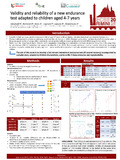
Currently, there is no field test to assess aerobic endurance in children aged 4-7 years, while taking into account the physiological and psychological characteristics specific to this population. The main validated test is a 3-minute continuous, round-trip 10m run (Ayan et al, 2015). However, studies show that intermittent effort is better suited to the physiological specifics of young children, notably due to their greater ability to recover quickly between brief efforts (Baquet et al., 2010). Furthermore, the integration of playful elements, such as imaginative storytelling or dramatizations, could not only increase the pleasure felt during effort, but also improve childrens motivation and engagement (Howells et al., 2023). These playful approaches seem particularly relevant for encouraging adherence to physical activity from an early age, and it seems worthwhile to propose a positively perceived endurance assessment test for younger children.
METHODS:
To take into account the particularities of the target age group, we developed a 3x1 minute intermittent endurance test (recovery = 30 seconds) accompanied by a story to make it fun. To study the validity of the test and the influence of the variables “intermittent effort” and “playful context”, 80 children will perform the test under 4 conditions: continuous non-playful test (reference test); continuous playful test; intermittent non-playful test; intermittent playful test. To study reliability, 80 children will perform both intermittent non-playful test and intermittent playful test twice. Children level of exhaustion and the level of amusement will be assessed using emoticons scales.
RESULTS:
Preliminary tests have been carried out to arrive at a rigorous organization enabling the evaluation of a class (around 20 children) in a single session lasting less than 45 minutes. Measurements for validity and reliability are currently underway. Full results will be available at the conference.
CONCLUSION:
We hypothesize that the playful intermittent test will be well suited to the 4 to 7 year-old population. We hypothesize that overall validity and reliability will be good, but influenced by the age of the children, and lower in the youngest age groups. We hypothesize that, at the end of the new test, children will report a level of exhaustion comparable to other tests, but will report a higher fun score.
References
1. Ayán et al (2015) JSCR. 29(10), 2874-2880
2. Baquet et al (2010) JSCR 24(5), 1381-1388
3. Howells et al (2023) JECER (12)1
Research Center/Unit :
RUCHE - Research Unit for a life-Course perspective on Health & Education - ULiège
Disciplines :
Human health sciences: Multidisciplinary, general & others
Author, co-author :
Jidovtseff, Boris ; Université de Liège - ULiège > Département des Sciences de l'activité physique et de la réadaptation > Déterminants de la performance et aspects généraux de l'entraînement - Aspects spécifiques de l'entraînement y compris de haut niveau
Lejeune, Robin ; Université de Liège - ULiège > Faculté de Médecine > Master sc. motr., or. éd. phys., fin. did.