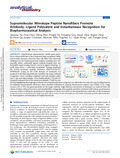
[en] Peptide-based supramolecules exhibit great potential in various fields due to their improved target recognition ability and versatile functions. However, they still suffer from numerous challenges for the biopharmaceutical analysis, including poor self-assembly ability, undesirable ligand-antibody binding rates, and formidable target binding barriers caused by ligand crowding. To tackle these issues, a "polyvalent recognition" strategy employing the CD20 mimotope peptide derivative NBD-FFVLR-GS-WPRWLEN (acting on the CDR domains of rituximab) was proposed to develop supramolecular nanofibers for target antibody recognition. These nanofibers exhibited rapid self-assembly within only 1 min and robust stability. Their binding affinity (179 nM) for rituximab surpassed that of the monomeric peptide (7 μM) by over 38-fold, highlighting that high ligand density and potential polyvalent recognition can efficiently overcome the target binding barriers of traditional supramolecules. Moreover, these nanofibers exhibited an amazing "instantaneous capture" rate (within 15 s), a high recovery (93 ± 3%), and good specificity for the target antibody. High-efficiency enrichment of rituximab was achieved from cell culture medium with good recovery and reproducibility. Intriguingly, these peptide nanofibers combined with bottom-up proteomics were successful in tracking the deamidation of asparagine 55 (from 10 to 16%) on the rituximab heavy chain after 21 day incubation in human serum. In summary, this study may open up an avenue for the development of versatile mimotope peptide supramolecules for biorecognition and bioanalysis of biopharmaceuticals.
Research Center/Unit :
CIRM - Centre Interdisciplinaire de Recherche sur le Médicament - ULiège
Disciplines :
Pharmacy, pharmacology & toxicology
Author, co-author :
He, Qiaoxian; Institute of Pharmaceutical Analysis, College of Pharmacy/State Key Laboratory of Bioactive Molecules and Druggability Assessment/International Cooperative Laboratory of Traditional Chinese Medicine Modernization and Innovative Drug Development of Ministry of Education (MOE) of China, Jinan University, Guangzhou 510632, China
Chen, Feng; Institute of Pharmaceutical Analysis, College of Pharmacy/State Key Laboratory of Bioactive Molecules and Druggability Assessment/International Cooperative Laboratory of Traditional Chinese Medicine Modernization and Innovative Drug Development of Ministry of Education (MOE) of China, Jinan University, Guangzhou 510632, China
Zhao, Zheng; Institute of Pharmaceutical Analysis, College of Pharmacy/State Key Laboratory of Bioactive Molecules and Druggability Assessment/International Cooperative Laboratory of Traditional Chinese Medicine Modernization and Innovative Drug Development of Ministry of Education (MOE) of China, Jinan University, Guangzhou 510632, China
Pei, Pengfei; Beijing Key Laboratory of Bioprocess, College of Life Science and Technology, Beijing University of Chemical Technology, Beijing 100029, P. R. China
Gan, Yongqing; School of Basic Medicine and Clinical Pharmacy, China Pharmaceutical University, Nanjing 210009, China
Zhou, Aixuan; Institute of Pharmaceutical Analysis, College of Pharmacy/State Key Laboratory of Bioactive Molecules and Druggability Assessment/International Cooperative Laboratory of Traditional Chinese Medicine Modernization and Innovative Drug Development of Ministry of Education (MOE) of China, Jinan University, Guangzhou 510632, China
Zhou, Jingwei; Institute of Pharmaceutical Analysis, College of Pharmacy/State Key Laboratory of Bioactive Molecules and Druggability Assessment/International Cooperative Laboratory of Traditional Chinese Medicine Modernization and Innovative Drug Development of Ministry of Education (MOE) of China, Jinan University, Guangzhou 510632, China
Qu, Jia-Huan; Institute of Pharmaceutical Analysis, College of Pharmacy/State Key Laboratory of Bioactive Molecules and Druggability Assessment/International Cooperative Laboratory of Traditional Chinese Medicine Modernization and Innovative Drug Development of Ministry of Education (MOE) of China, Jinan University, Guangzhou 510632, China
Crommen, Jacques ; Université de Liège - ULiège > Département de pharmacie ; Institute of Pharmaceutical Analysis, College of Pharmacy/State Key Laboratory of Bioactive Molecules and Druggability Assessment/International Cooperative Laboratory of Traditional Chinese Medicine Modernization and Innovative Drug Development of Ministry of Education (MOE) of China, Jinan University, Guangzhou 510632, China
Fillet, Marianne ; Université de Liège - ULiège > Département de pharmacie > Analyse des médicaments ; Institute of Pharmaceutical Analysis, College of Pharmacy/State Key Laboratory of Bioactive Molecules and Druggability Assessment/International Cooperative Laboratory of Traditional Chinese Medicine Modernization and Innovative Drug Development of Ministry of Education (MOE) of China, Jinan University, Guangzhou 510632, China
Li, Yingchun ; School of Science, Harbin Institute of Technology, Shenzhen, Guangdong 518055, China
Wang, Qiqin; Institute of Pharmaceutical Analysis, College of Pharmacy/State Key Laboratory of Bioactive Molecules and Druggability Assessment/International Cooperative Laboratory of Traditional Chinese Medicine Modernization and Innovative Drug Development of Ministry of Education (MOE) of China, Jinan University, Guangzhou 510632, China
Jiang, Zhengjin ; Institute of Pharmaceutical Analysis, College of Pharmacy/State Key Laboratory of Bioactive Molecules and Druggability Assessment/International Cooperative Laboratory of Traditional Chinese Medicine Modernization and Innovative Drug Development of Ministry of Education (MOE) of China, Jinan University, Guangzhou 510632, China
NSCF - National Natural Science Foundation of China
Funding text :
This work was supported by the National Natural Science Foundation of China (82373829, 82273893, and 82173773), the Natural Science Foundation of Guangdong Province, China (2021A1515220099 and 2022A1515011576), the High-End Foreign Experts Project, China (G2021199005L), and the Science and Technology Program of Guangdong Provincial Medical Products Administration, China (2023TDZ11, 2022ZDB04).
Levin, A.; Hakala, T. A.; Schnaider, L.; Bernardes, G. J. L.; Gazit, E.; Knowles, T. P. J. Biomimetic Peptide Self-Assembly for Functional Materials. Nat. Rev. Chem 2020, 4, 615- 634, 10.1038/s41570-020-0215-y
Wang, M. D.; Lv, G. T.; An, H. W.; Zhang, N. Y.; Wang, H. In Situ Self-Assembly of Bispecific Peptide for Cancer Immunotherapy. Angew. Chem., Int. Ed. 2022, 61, e2021136 10.1002/anie.202113649
Wang, M. D.; Hou, D. Y.; Lv, G. T.; Li, R. X.; Hu, X. J.; Wang, Z. J.; Zhang, N. Y.; Yi, L.; Xu, W. H.; Wang, H. Targeted in Situ Self-Assembly Augments Peptide Drug Conjugate Cell-Entry Efficiency. Biomaterials 2021, 278, 121139, 10.1016/j.biomaterials.2021.121139
Wu, Y.; Wen, H.; Bernstein, Z. J.; Hainline, K. M.; Blakney, T. S.; Congdon, K. L.; Snyder, D. J.; Sampson, J. H.; Sanchez-Perez, L.; Collier, J. H. Multiepitope Supramolecular Peptide Nanofibers Eliciting Coordinated Humoral and Cellular Antitumor Immune Responses. Sci. Adv. 2022, 8, eabm7833 10.1126/sciadv.abm7833
Li, Y.; Lock, L. L.; Wang, Y.; Ou, S. H.; Stern, D.; Schön, A.; Freire, E.; Xu, X.; Ghose, S.; Li, Z. J.; Cui, H. Bioinspired Supramolecular Engineering of Self-Assembling Immunofibers for High Affinity Binding of Immunoglobulin G. Biomaterials 2018, 178, 448- 457, 10.1016/j.biomaterials.2018.04.032
Li, Y.; Lock, L. L.; Mills, J.; Ou, B. S.; Morrow, M.; Stern, D.; Wang, H.; Anderson, C. F.; Xu, X.; Ghose, S.; Li, Z. J.; Cui, H. Selective Capture and Recovery of Monoclonal Antibodies by Self-Assembling Supramolecular Polymers of High Affinity for Protein Binding. Nano Lett. 2020, 20, 6957- 6965, 10.1021/acs.nanolett.0c01297
Feng, Z.; Zhang, T.; Wang, H.; Xu, B. Supramolecular Catalysis and Dynamic Assemblies for Medicine. Chem. Soc. Rev. 2017, 46, 6470- 6479, 10.1039/C7CS00472A
Li, Q.; Min, J.; Zhang, J.; Reches, M.; Shen, Y.; Su, R.; Wang, Y.; Qi, W. Enzyme-Driven, Switchable Catalysis Based on Dynamic Self-Assembly of Peptides. Angew. Chem., Int. Ed. 2023, 62, e202309830 10.1002/anie.202309830
Li, L. L.; Qiao, Z. Y.; Wang, L.; Wang, H. Programmable Construction of Peptide-Based Materials in Living Subjects: from Modular Design and Morphological Control to Theranostics. Adv. Mater. 2019, 31, 1804971, 10.1002/adma.201804971
Li, T.; Lu, X. M.; Zhang, M. R.; Hu, K.; Li, Z. Peptide-Based Nanomaterials: Self-Assembly, Properties and Applications. Bioact. Mater. 2022, 11, 268- 282, 10.1016/j.bioactmat.2021.09.029
Wang, J.; Li, Y.; Nie, G. Multifunctional Biomolecule Nanostructures for Cancer Therapy. Nat. Rev. Mater. 2021, 6, 766- 783, 10.1038/s41578-021-00315-x
An, H. W.; Li, L. L.; Wang, Y.; Wang, Z.; Hou, D.; Lin, Y. X.; Qiao, S. L.; Wang, M. D.; Yang, C.; Cong, Y.; Ma, Y.; Zhao, X. X.; Cai, Q.; Chen, W. T.; Lu, C. Q.; Xu, W.; Wang, H.; Zhao, Y. A Tumour-Selective Cascade Activatable Self-Detained System for Drug Delivery and Cancer Imaging. Nat. Commun. 2019, 10, 4861, 10.1038/s41467-019-12848-5
An, H. W.; Mamuti, M.; Wang, X.; Yao, H.; Wang, M. D.; Zhao, L.; Li, L. L. Rationally Designed Modular Drug Delivery Platform Based on Intracellular Peptide Self-Assembly. Exploration 2021, 1, 20210153, 10.1002/EXP.20210153
Han, S.; Cao, S.; Wang, Y.; Wang, J.; Xia, D.; Xu, H.; Zhao, X.; Lu, J. R. Self-Assembly of Short Peptide Amphiphiles: The Cooperative Effect of Hydrophobic Interaction and Hydrogen Bonding. Chem.─Eur. J. 2011, 17, 13095- 13102, 10.1002/chem.201101970
Zhang, L.; Jing, D.; Jiang, N.; Rojalin, T.; Baehr, C. M.; Zhang, D.; Xiao, W.; Wu, Y.; Cong, Z.; Li, J. J.; Li, Y.; Wang, L.; Lam, K. S. Transformable Peptide Nanoparticles Arrest HER2 Signalling and Cause Cancer Cell Death in Vivo. Nat. Nanotechnol. 2020, 15, 145- 153, 10.1038/s41565-019-0626-4
Knowles, T. P.; Fitzpatrick, A. W.; Meehan, S.; Mott, H. R.; Vendruscolo, M.; Dobson, C. M.; Welland, M. E. Role of Intermolecular Forces in Defining Material Properties of Protein Nanofibrils. Science 2007, 318, 1900- 1903, 10.1126/science.1150057
Huang, S.; Wang, W.; Li, J.; Zhang, T.; Liang, Y.; Wang, Q.; Jiang, Z. Multifunctional DNA Mediated Spatially Confined Assembly for Antibody Orientation: Surpassing Sensitivity and Accuracy for Rituximab Detection. Chem. Eng. J. 2021, 419, 129613, 10.1016/j.cej.2021.129613
Huang, S.; Tang, R.; Zhang, T.; Zhao, J.; Jiang, Z.; Wang, Q. Anti-Fouling Poly Adenine Coating Combined with Highly Specific CD20 Epitope Mimetic Peptide for Rituximab Detection in Clinical Patients’ Plasma. Biosens. Bioelectron. 2021, 171, 112678, 10.1016/j.bios.2020.112678
Lu, L.; Liu, X.; Zuo, C.; Zhou, J.; Zhu, C.; Zhang, Z.; Fillet, M.; Crommen, J.; Jiang, Z.; Wang, Q. In Vitro/in Vivo Degradation Analysis of Trastuzumab by Combining Specific Capture on HER2Mimotope Peptide Modified Material and LC-QTOF-MS. Anal. Chim. Acta 2022, 1225, 340199, 10.1016/j.aca.2022.340199
Lei, Y.; Liu, X.; Lu, L.; Liu, C.; Xu, R.; Huang, S.; Shen, Y.; Deng, C.; Yu, J.; Zhang, T.; Crommen, J.; Wang, Q.; Jiang, Z. Rapid Preparation of 1-Vinylimidazole Based Non-Affinity Polymers for the Highly-Selective Purification of Antibodies from Multiple Biological Sources. J. Chromatogr. A 2020, 1632, 461607, 10.1016/j.chroma.2020.461607
Lei, Y.; Shen, Y.; Zuo, C.; Lu, L.; Crommen, J.; Wang, Q.; Jiang, Z. Emerging Affinity Ligands and Support Materials for the Enrichment of Monoclonal Antibodies. TrAC, Trends Anal. Chem. 2022, 157, 116744, 10.1016/j.trac.2022.116744
Mammen, M.; Choi, S. K.; Whitesides, G. M. Polyvalent Interactions in Biological Systems: Implications for Design and Use of Multivalent Ligands and Inhibitors. Angew. Chem., Int. Ed. 1998, 37, 2754- 2794, 10.1002/(SICI)1521-3773(19981102)37:20<2754::AID-ANIE2754>3.0.CO;2-3
Men, D.; Zhou, J.; Li, W.; Wei, C. H.; Chen, Y. Y.; Zhou, K.; Zheng, Y.; Xu, K.; Zhang, Z. P.; Zhang, X. E. Self-Assembly of Antigen Proteins into Nanowires Greatly Enhances the Binding Affinity for High-Efficiency Target Capture. ACS Appl. Mater. Interfaces 2018, 10, 41019- 41025, 10.1021/acsami.8b12511
Fan, J. Q.; Li, Y. J.; Wei, Z. J.; Fan, Y.; Li, X. D.; Chen, Z. M.; Hou, D. Y.; Xiao, W. Y.; Ding, M. R.; Wang, H.; Wang, L. Binding-Induced Fibrillogenesis Peptides Recognize and Block Intracellular Vimentin Skeletonization against Breast Cancer. Nano Lett. 2021, 21, 6202- 6210, 10.1021/acs.nanolett.1c01950
Hu, X. X.; He, P. P.; Qi, G. B.; Gao, Y. J.; Lin, Y. X.; Yang, C.; Yang, P. P.; Hao, H.; Wang, L.; Wang, H. Transformable Nanomaterials as an Artificial Extracellular Matrix for Inhibiting Tumor Invasion and Metastasis. ACS Nano 2017, 11, 4086- 4096, 10.1021/acsnano.7b00781
Yang, P. P.; Li, Y. J.; Cao, Y.; Zhang, L.; Wang, J. Q.; Lai, Z.; Zhang, K.; Shorty, D.; Xiao, W.; Cao, H.; Wang, L.; Wang, H.; Liu, R.; Lam, K. S. Rapid Discovery of Self-Assembling Peptides with One-Bead One-Compound Peptide Library. Nat. Commun. 2021, 12, 4494, 10.1038/s41467-021-24597-5
König, N.; Szostak, S. M.; Nielsen, J. E.; Dunbar, M.; Yang, S.; Chen, W.; Benjamin, A.; Radulescu, A.; Mahmoudi, N.; Willner, L.; Keten, S.; Dong, H.; Lund, R. Stability of Nanopeptides: Structure and Molecular Exchange of Self-assembled Peptide Fibers. ACS Nano 2023, 17, 12394- 12408, 10.1021/acsnano.3c01811
Chen, Z.; Zhu, C.; Yang, J.; Zhang, M.; Yuan, J.; Shen, Y.; Zhou, J.; Huang, H.; Xu, D.; Crommen, J.; Jiang, Z.; Wang, Q. Inside-Out Oriented Choline Phosphate-Based Biomimetic Magnetic Nanomaterials for Precise Recognition and Analysis of C-Reactive Protein. Anal. Chem. 2023, 95, 3532- 3543, 10.1021/acs.analchem.2c05683
Yang, J.; Zhou, A.; Li, M.; He, Q.; Zhou, J.; Crommen, J.; Wang, W.; Jiang, Z.; Wang, Q. Mimotope Peptide Modified Pompon Mum-Like Magnetic Microparticles for Precise Recognition, Capture and Biotransformation Analysis of Rituximab in Biological Fluids. Acta Pharm. Sin. B 2024, 14, 1317- 1328, 10.1016/j.apsb.2023.10.018
Arabi, M.; Ostovan, A.; Zhang, Z.; Wang, Y.; Mei, R.; Fu, L.; Wang, X.; Ma, J.; Chen, L. Label-Free SERS Detection of Raman-Inactive Protein Biomarkers by Raman Reporter Indicator: Toward Ultrasensitivity and Universality. Biosens. Bioelectron. 2021, 174, 112825, 10.1016/j.bios.2020.112825
Arora, S.; Saxena, V.; Ayyar, B. V. Affinity Chromatography: A Versatile Technique for Antibody Purification. Methods 2017, 116, 84- 94, 10.1016/j.ymeth.2016.12.010
Padwal, P.; Finger, C.; Fraga-García, P.; Kaveh-Baghbaderani, Y.; Schwaminger, S. P.; Berensmeier, S. Seeking Innovative Affinity Approaches: A Performance Comparison between Magnetic Nanoparticle Agglomerates and Chromatography Resins for Antibody Recovery. ACS Appl. Mater. Interfaces 2020, 12, 39967- 39978, 10.1021/acsami.0c05007
Kaveh-Baghbaderani, Y.; Allgayer, R.; Schwaminger, S. P.; Fraga-García, P.; Berensmeier, S. Magnetic Separation of Antibodies with High Binding Capacity by Site-Directed Immobilization of Protein A-Domains to Bare Iron Oxide Nanoparticles. ACS Appl. Nano Mater. 2021, 4, 4956- 4963, 10.1021/acsanm.1c00487
Tehrani Najafian, F.; Bibi, N. S.; Islam, T.; Fernández-Lahore, M. A Megaporous Material Harbouring a Peptide Ligand for Affinity IgG Purification. Electrophoresis 2017, 38, 2914- 2921, 10.1002/elps.201700198
Nupur, N.; Rathore, A. S. Elucidating Chemical and Disulfide Heterogeneities in Rituximab Using Reduced and Non-Reduced Peptide Mapping. J. Sep. Sci. 2022, 45, 2887- 2900, 10.1002/jssc.202200290
Di Marco, F.; Berger, T.; Esser-Skala, W.; Rapp, E.; Regl, C.; Huber, C. G. Simultaneous Monitoring of Monoclonal Antibody Variants by Strong Cation-Exchange Chromatography Hyphenated to Mass Spectrometry to Assess Quality Attributes of Rituximab-Based Biotherapeutics. Int. J. Mol. Sci. 2021, 22, 9072, 10.3390/ijms22169072