Abstract :
[en] Numerous amniote lineages independently invaded the marine environments during the
Mesozoic, including ichthyosaurians, plesiosaurians, mosasaurids, and marine
crocodylomorphs. These groups evolved a range of craniodental morphologies that likely
reflect distinct feeding strategies, prey specialisations, sensory capabilities, and hydrodynamic adaptations, enabling them to occupy high trophic levels within their ecosystems. Despite a growing interest in the evolutionary ecology of marine reptiles, large-scale quantitative assessments of their functional morphology across the entire Mesozoic remain relatively scarce, as most studies have focused on specific clades, time intervals, or anatomical regions (e.g., jaw shape, dentition).
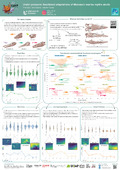
Here, we present preliminary analyses of craniodental functional disparity throughout the entire history of Mesozoic marine reptiles, from the Triassic to the end of the Cretaceous. Our dataset comprises continuous and discrete morphological traits from over 450 taxa, making it the most extensive dataset of 2D and 3D craniodental data for Mesozoic marine reptiles to date, to our knowledge. Data was gathered from published sources, personal examination, and digital three-dimensional models. We used functionally relevant ratios to quantify disparity and track the evolution of key biomechanical traits across multiple temporal bins. To investigate potential adaptive pressures and peaks, we computed adaptive landscapes using the R package ‘Morphoscape’, focusing on traits related to feeding biomechanics (e.g., mechanical advantage), sensory capabilities (e.g., orbit size), and hydrodynamics (e.g., snout shape). Preliminary results show that the Middle to Late Triassic was a moment of high functional disparity and ecological experimentation, while the Jurassic and Early Cretaceous are characterised by relative functional stability, particularly among dominant groups such as parvipelvian ichthyosaurians, plesiosaurians, and thalattosuchian crocodylomorphs. During the Late Cretaceous, mosasaurids seem to adopt a different high-bite force optimal skull architecture compared to coeval and older plesiosaurians – a configuration previously only explored by a few metriorhynchoids. By combining ecomorphological analyses with adaptive landscape modelling, our approach helps reveal potential selective pressures and constraints
that shaped the macroevolution of craniodental forms in Mesozoic marine reptiles.