Silver nanowire networks; Vanadium dioxide; Thermochromic stack; Figure of Merit; Low-emissivity; Numerical simulations; Transfer matrix method
Abstract :
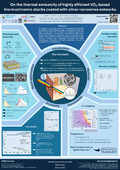
[en] In the ever-increasingly important context of energy-efficient building technologies, the development of low-emissivity coatings is of particular significance. Among the noteworthy approaches contributing to this advancement are thermochromic materials, which allow for dynamic control of light transmission through reversible, thermally-induced transitions in optical properties. In particular, the unique properties of vanadium dioxide (VO2) have captured considerable attention within the scientific community, primarily owing to its favorable characteristics such as a relatively low and easily adjustable transition temperature.
In this work, we present the design of a VO2-based thermochromic stack that allows for optimal solar modulation (ΔTsol) and luminous transparency (Tlum) with tunable near-infrared thermal emissivity. Given the recent advancements in the investigation of the low-emissivity properties of silver nanowire (Ag NW) networks, our investigation focuses on the development of a Ag NW-coated stack that makes use of optical impedance matching (SiO2 and TiO2) and solar modulation enhancer (Ag) layers. The transfer-matrix approach is employed to model light propagation in this multilayered structure and to derive its associated optical properties. We propose an innovative design that yields impressive simultaneous ΔTsol and Tlum values for the stack without Ag NWs, reaching up to 13.5% and 71%, respectively. Our research enables the determination of the thermal emissivity (ϵ) of the stack and shows that it can easily be tuned by adjusting the density of the deposited network. The quantification of this emissivity’s tuning on the aforementionned thermochromic properties serves as a valuable reference for the design of low-emissivity coatings for energy-saving applications. Importantly, our findings reveal that the emissivity of the stack can be reduced by more than 50% by keeping Tlum > 50% and ΔTsol around 10%. This insight underscores the potential for substantial emissivity reduction in the pursuit of energy-efficient technologies.
Disciplines :
Physics
Author, co-author :
Baret, Amaury ; Université de Liège - ULiège > Département de physique > Physique des solides, interfaces et nanostructures
Khan, Ambreen; University of Bordeaux > ICMCB ; UGA - Universite Grenoble Alpes > INP PHELMA > LMGP