Pig; Pig husbandry; Animal density; Social stress; Inulin; Prebiotic; SCFA; Short-chain fatty acids; Gene expression; Instestinal health
Abstract :
[en] Social stress in piglets poses welfare and production issues for the pig industry. Through the gut-brain axis, social stress relates with intestinal health. This study evaluated the combined effects of inulin and chronic social stress on molecular, physiological, and production-level indicators of intestinal health in piglets.
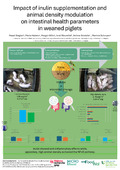
A total of 144 piglets, sex ratio 50:50, were weaned at 4 weeks of age and fed for 4 weeks a control or inulin diet (nutrient adequate with 0 or 10g inulin/kg feed) in 12 pens with high (n=14) or low (n=10) animal densities (2.75 vs 1.96 pigs/m²). At 8 weeks of age, 12 piglets/treatment were slaughtered for intestinal sampling. Inflammatory and permeability gene expression (qPCR) and histomorphological structure were analysed in intestinal tissue. Short-chain fatty acids (SCFA) were measured (HPLC) in intestinal content. Outliers were removed using QQPlot, and ANOVA was performed. Body weight, feed intake and histomorphology showed no differences between treatments. In the colon, BAX, IL1α and IL6 expression decreased with inulin (P<0.05) but IL1α increased in high density pens (P<0.05). No diet-density interaction was found for any of the parameters. In the ileum, TANK expression decreased with high density (P<0.05). SCFA profiles showed higher molar ratio of isobutyric acid in the colon and higher acetic acid molar amounts in the jejunum of inulin fed pigs while high density lowered molar amounts of propionic acid in the jejunum (P<0.05).
Inulin showed anti-inflammatory effects while, oppositely, high animal density activated the NFκB pathway. Despite molecular signs of social stress and the effect of inulin, piglet performance was minimally impacted, likely due to insufficient stressor and a low inulin inclusion rate. No significant interactions between inulin and density were found, suggesting each affects intestinal health independently. Addressing high density stress remains critical for improving gut health and performance in piglets.
Research Center/Unit :
TERRA Research Centre. Animal Sciences - ULiège
Disciplines :
Animal production & animal husbandry
Author, co-author :
Siegien, Pawel ; Université de Liège - ULiège > Département GxABT > Animal Sciences (AS)
Habets, Marie ; Université de Liège - ULiège > Gembloux Agro-Bio Tech > Master bioing. : sc. agrono., à fin. spéc.
Gillis, Margot ; Université de Liège - ULiège > Département GxABT > Animal Sciences (AS)
Wavreille, José; CRA-W - Centre Wallon de Recherches agronomiques > Département productions agricoles > Unité productions animales
Bindelle, Jérôme ; Université de Liège - ULiège > Département GxABT > Animal Sciences (AS)
Schroyen, Martine ; Université de Liège - ULiège > TERRA Research Centre > Animal Sciences (AS)
Language :
English
Title :
Impact of inulin supplementation and animal density modulation on intestinal health parameters in weaned piglets
Publication date :
May 2025
Event name :
16th International Symposium on Digestive Physiology of Pigs (DPP 2025)
Event place :
United States - Wisconsin
Event date :
20-23 May 2025
Audience :
International
Peer review/Selection committee :
Editorial reviewed
Name of the research project :
WIN4EXCELLENCE - FoodWal - MICROBoost
Funders :
SPW EER - Service Public de Wallonie Economie, Emploi, Recherche. Département de l'Emploi et de la Formation professionnelle
Funding number :
2210182
Funding text :
The research leading to these results has been funded by the Public Service of Wallonia
(Economy, Employment and Research), under the FoodWal agreement n°2210182 from the Win4Excellence project of the Wallonia Recovery Plan