bite marks; morderolite; Neogene; trophic interaction; white shark tooth; Seal calcaneum
Abstract :
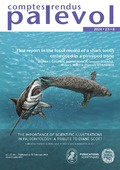
[en] There are now many examples in the fossil record of shark bite marks preserved on biogenic materials including coprolites, ammonoids, sea star ossicles, an echinoid, and bone and calcified cartilage. These exceptional fossils document evidence of exploratory behavior, active predation, and/or scavenging. However, only a small subset report on the presence of shark teeth embedded in fossilized bone or cartilage. Although a few shark tooth-marked seal bones are known from the fossil record, no direct evidence of predation or scavenging in the form of a shark tooth embedded in a fossil seal bone has yet been documented. Herein, we describe the first shark tooth embedded in a seal (Phocidae Gray, 1821) bone, a calcaneum (CMM-V-6964), that was surface collected in Mosaic’s South Fort Meade Mine, Hardee County, Fort Meade, Florida, United States. The isolated bone originated from within the Bone Valley Member of the Peace River Formation (Hawthorn Group). The partial tooth is identified as having come from an Early Pliocene great white shark, Carcharodon carcharias (Linnaeus, 1758). This discovery also represents the first C. carcharias tooth ever found embedded in a fossil bone. The embedded tooth may have come about as a result of active predation or scavenging. The extant macropredatory sharks, Carcharodon carcharias (great white shark), Notorynchus cepedianus (Péron, 1807) (sevengill shark), Somniosus microcephalus (Bloch & Schneider, 1801) (the Greenland shark), and Somniosus antarcticus Whitley, 1939 (sleeper shark), are known to actively prey upon seals (Pinnipedia Illiger, 1811). If this peculiar fossil association resulted from active predation, the seal did not survive the encounter because there is no evidence of healing in the area around the embedded shark tooth.
Disciplines :
Earth sciences & physical geography
Author, co-author :
Godfrey, Stephen J.; Department of Paleontology, Calvert Marine Museum, Solomons, United States ; Department of Paleobiology, National Museum of Natural History, Smithsonian Institution, Washington, United States
Murdoch, Paul; United States
Dewaele, Leonard ; Université de Liège - ULiège > Département de géologie > Evolution and diversity dynamics lab ; Chef de travaux Directorate of Earth and History of Life, Royal Belgian Institute of Natural Sciences, Brussels, Belgium ; FunMorph Lab, Department of Biology, Antwerp University, Campus Drie Eiken, Antwerp, Belgium
Perez, Victor J.; Environmental Studies Department, St. Mary’s College of Maryland, St. Mary’s City, St. Mary's City, United States
Schumaker, Clarence; Daybreak Studios, Chesapeake Beach, United States
Language :
English
Title :
First report in the fossil record of a shark tooth embedded in a pinniped bone
We would like to express our thanks to CMM Paleontology Collections Manager, John R. Nance for encouraging access to specimens in his care. We are also grateful to the constructive reviews given by Dr Robert W. Boessenecker (Mace Brown Museum of Natural History, College of Charleston), Dr Alberto Collareta (Museo di Storia Naturale, Università di Pisa), and Dr Olivier Lambert (Institut royal des Sciences naturelles de Belgique, Belgium), which improved upon our initial effort, and Dr Michel Laurin who kept the manuscript moving through the publication process. We are grateful that Dr Robert R. Reisz invited us to contribute to this issue. This research was funded in part by the citizens of Calvert County Maryland, the County Board of Calvert County Commissioners, and the Clarissa and Lincoln Dryden Endowment for Paleontology at the Calvert Marine Museum.
AGuilerA o. A., GArcíA l. & cozzuol m. A. 2008. — Giant-toothed white sharks and cetacean trophic interaction from the Pliocene Caribbean Paraguaná Formation. Paläontologische Zeitschrift 82: 204-208. https://doi.org/10.1007/BF02988410
Ames J. A. & moreJohn G. v. 1980. — Evidence of white shark, Carcharodon carcharias, attacks on sea otters, Enhydra lutris. California Fish and Game 66: 196-209.
bertA A. & Wyss A. r. 1994. — Pinniped phylogeny. Proceedings of the San Diego Society of Natural History 29: 33-56.
bertA A., churchill m. & boessenecker r. W. 2018. — The origin and evolutionary biology of Pinnipeds: seals, sea lions, and walruses. Annual Review of Earth and Planetary Sciences 46: 203-228. https://doi.org/10.1146/annurev-earth-082517-010009
biAnucci G., bisconti m., lAnDini W., storAi t., zuffA m., GiuliAni s. & moJettA A. 2002. — Trophic interactions between white sharks (Carcharodon carcharias) and cetaceans: a comparison between Pliocene and recent data, in vAcchi m., lA mesA G., serenA f. & sèret B. (eds), Proceedings 4th meeting of the European Elasmobranch Association, Livorno (Italy) 27-30 September 2000. Imprimerie F. Paillart, Abbeville: 33-48.
biGeloW p. k. 1994. — Occurrence of a squaloid shark (Chondrichthyes: Squaliformes) with the pinniped Allodemus from the Upper Miocene of Washington. Journal of Paleontology 68 (3): 680-684. https://doi.org/10.1017/s0022336000026032
boessenecker r. W. & forDyce r. e. 2015. — Trace fossil evidence of predation upon bone-eating worms on a baleen whale skeleton from the Oligocene of New Zealand. Lethaia 48 (3): 326-331. https://doi.org/10.1111/let.12108
boessenecker r. W., perry f. A. & schmitt J. G. 2014. — Comparative taphonomy, taphofacies, and bonebeds of the Mio-Pliocene Purisima Formation, Central California: strong physical control on marine vertebrate preservation in shallow marine settings. PLoS ONE 9 (3): e91419. https://doi.org/10.1371/journal.pone.0091419
cicimurri D. J. & kniGht J. l. 2009. — Two shark-bitten whale skeletons from Coastal Plain deposits of South Carolina. Southeastern Naturalist 8 (1): 71-82. https://www.jstor.org/stable/25599297
collAretA A., lAmbert o., lAnDini W., Di celmA c., mAlinverno e., vArAs-mAlcA r., urbinA m. & biAnucci G. 2017. — Did the giant extinct shark Carcharocles megalodon target small prey? Bite marks on marine mammal remains from the late Miocene of Peru. Palaeogeography, Palaeoclimatology, Palaeoecology 469: 84-91. https://doi.org/10.1016/j.palaeo.2017.01.001
collAretA A., tsAi c. h., coletti G. & bosselAers m. 2021. — Thatchtelithichnus on a Pliocene grey whale mandible and barnacles as possible tracemakers. Neues Jahrbuch für Geologie und Paläontologie-Abhandlungen 302: 53-61. https://doi.org/10.1127/njgpa/2021/1018
collAretA A., merellA m., cAsAti s., Di cencio A. & biAnucci G. 2022. — Smoking guns for cold cases: the find of a Carcharhinus tooth piercing a fossil cetacean rib, with notes on the feeding ecology of some Mediterranean Pliocene requiem sharks. Neues Jahrbuch für Geologie und Paläontologie-Abhandlungen 305: 145-152. https://doi.org/10.1127/njgpa/2022/1082
cortés D., De GrAciA c., cArrillo-briceño J. D., AGuirrefernánDez G., JArAmillo c., benites-pAlomino A. & Atencio-ArAúz J. e. 2019. — Shark-cetacean trophic interactions during the late Pliocene in the Central Eastern Pacific (Panama). Palaeontologia Electronica 22 (2): 49A 1-13. https://doi.org/10.26879/953
De vos A., o’riAin m. J., meyer m. A., kotze p. G. & kock A. A. 2015. — Behavior of Cape fur seals (Arctocephalus pusillus pusillus) in relation to temporal variation in predation risk by white sharks (Carcharodon carcharias) around a seal rookery in False Bay, South Africa. Marine Mammal Science 31 (3): 1118-1131. https://doi.org/10.1111/mms.12208
DeWAele l., pereDo c. m., meyvisch p. & louWye s. 2018. — Diversity of late Neogene Monachinae (Carnivora, Phocidae) from the North Atlantic, with the description of two new species. Royal Society Open Science 5 (3): 172437. https://doi.org/10.1098/rsos.172437
DieDrich c. G. 2013. — Evolution of white and megatooth sharks, and evidence for early predation on seals, sirenians, and whales. Natural Science 5 (11): 1203-1218. https://doi.org/10.4236/ns.2013.511148
ebert D. A. 1991. — Observations on the predatory behaviour of the sevengill shark Notorynchus cepedianus. South African Journal of Marine Science 11 (1): 455-465. https://doi.org/10.2989/025776191784287637
ehret D. J., mAcfADDen b. J., Jones D. s., Devries t. J. & sAlAs-GismonDi r. 2009. — Caught in the act: trophic interactions between a 4-million-year-old white shark (Carcharodon) and mysticete whale from Peru. Palaios 24: 329-333. https://doi.org/10.2110/palo.2008.p08-077r
ehret D. J., mAcfADDen b. J., Jones D. s., Devries t. J., foster D. A. & sAlAs-GismonDi r. 2012. — Origin of the white shark Carcharodon (Lamniformes: Lamnidae) based on recalibration of the Upper Neogene Pisco Formation of Peru. Palaeontology55(6):1139-1153.https://doi.org/10.1111/j.1475-4983.2012.01201.x
everhArt m. J., everhArt p. A. & shimADA k. 1995. — A New Specimen of Shark Bitten Mosasaur Vertebrae from the Smoky Hill Chalk (Upper Cretaceous) in Western Kansas. Abstracts, 127th Annual Meeting, Kansas Academy of Science 14: 19.
everhArt m. J. 2004. — Late Cretaceous interaction between predators and prey. Evidence of feeding by two species of shark on a mosasaur. PalArch, Vertebrate Palaeontology 1 (1): 1-7.
fAlloWs c., GAllAGher A. J. & hAmmerschlAG n. 2013. — White Sharks (Carcharodon carcharias) scavenging on whales and its potential role in further shaping the ecology of an apex predator. PLoS ONE 8 (4): e60797. https://doi.org/10.1371/journal.pone.0060797
frAzzettA T. H. 1988. — The mechanics of cutting and the form of shark teeth (Chondrichthyes, Elasmobranchii). Zoomorphology 108: 93-107. https://doi.org/10.1007/BF00539785
freschi A. 2017. — New Carcharodon scavenging evidence on Pliocene whale bones remains from Northern Appennines. Quaderni del Museo Civico di Storia Naturale di Ferrara 5: 33-36.
freschi A. & cAu s. 2021. — Nuovi segni d’interazione trofica tra Carcharodon carcharias ed un odontoceto dal bacino pliopleistocenico di Castell’Arquato (Piacenza, Appennino Settentrionale). Parva Naturalia 15: 133-156.
GoDfrey s. J. & collAretA A. 2022. — Suggested names for major classes of fossils. The Ecphora 37 (2): 25.
GovenDer r. 2015. — Shark-cetacean trophic interaction, Duinefontein, Koeberg, (5 Ma), South Africa. South African Journal of Science 111 (11-12): 1-7. https://doi.org/10.17159/sajs.2015/20140453
GovenDer r. 2021. — Shark–seal interaction off South Africa’s west coast during the early Pliocene (5 Ma). South African Journal of Science 117 (3/4): #8837. https://doi.org/10.17159/sajs.2021/8837
GovenDer r. & chinsAmy A. 2013. — Early Pliocene (5 Ma) shark-cetacean trophic interaction from Langebaanweg, Western Coast of South Africa. PALAIOS 28 (5): 270-277. https://doi.org/10.2110/palo.2012.p12-058r
Guertin l. A. 1998. — A Late Cenozoic Mixed Carbonate/Siliciclastic System, South Florida: Lithostratigraphy, Chronostratigraphy, and Sea-Level Record. PhD dissertation, University of Miami, Coral Gables, Florida, 424 p.
Guertin l. A., mcneill D. f., liDz b. h. & cunninGhAm k. J. 1999. — Chronologic model and transgressive-regressive signatures in the late Neogene siliciclastic foundation (Long Key Formation) of the Florida Keys. Journal of Sedimentary Research 69: 653-666. https://doi.org/10.2110/jsr.69.653
Guertin l. A., missimer t. m. & mcneill D. f. 2000. — Hiatal duration of correlative sequence boundaries from Oligocene–Pliocene mixed carbonate/siliciclastic sediments of the south Florida Platform. Sedimentary Geology 134 (1-2): 1-6. https://doi.org/10.1016/S0037-0738(00)00011-7
hAmmerschlAG n., mArtin r. A. & fAlloWs c. 2006. — Effects of environmental conditions on predator-prey interactions between white sharks (Carcharodon carcharias) and Cape fur seals (Arctocephalus pusillus pusillus) at Seal Island, South Africa. Environmental Biology of Fishes 76: 341-350. https://doi.org/10.1007/s10641-006-9038-z
hoff J. vAn Den & morrice m. G. 2008. — Sleeper shark (Somniosus antarcticus) and other bite wounds observed on southern elephant seals (Mirounga leonina) at Macquarie Island. Marine Mammal Science 24 (1): 239-247. https://doi.org/10.1111/j.17487692.2007.00181.x
hulbert Jr. r. c. 2001. — The Fossil Vertebrates of Florida. University Press of Florida, Gainesville, 384 p.
hunt A. p. & lucAs s. G. 2021. — The ichnology of vertebrate consumption: Dentalites, gastroliths and bromalites. New Mexico Museum of Natural History & Science Bulletin 87: 1-226.
JAmburA p. l., türtscher J., kinDlimAnn r., metscher b., pfAff c., stumpf s., Weber G. W. & kriWet J. 2020. — Evolutionary trajectories of tooth histology patterns in modern sharks (Chondrichthyes, Elasmobranchii). Journal of Anatomy 236 (5): 753-771. https://doi.org/10.1111/joa.13145
Johnson r. l., kesWick t., bester m. n. & oosthuizen W. h. 2009. — Encounters between white sharks and Cape fur seals in a shallow channel. Marine Biodivsity Records 1 (2): 1-5. https://doi.org/10.1017/s1755267209000682
kAllAl r. J., GoDfrey s. J. & ortner D. J. 2012. — Bone reactions on a Pliocene cetacean rib indicate short-term survival of predation event. International Journal of Osteoarchaeology 22 (3): 253-260. https://doi.org/10.1002/oa.1199
kent b. W. 1994. — Fossil Sharks of the Chesapeake Bay Region. Egan Rees & Boyer, Inc., Columbia, MD, 146 p.
klimley p. A., pyle p. & AnDerson s. D. 1996. — The behavior of white sharks and their pinniped prey during predatory attacks, in klimley A. p. & Ainley D. G. (eds), Great White Sharks, the Biology of Carcharodon carcharias. Chapter 16. Academic Press, San Diego: 175-191.
klimley A., le boeuf b., cAntArA k. m., richert J. e., DAvis s. f., vAn sommerAn s. & kelly J. t. 2001. — The hunting strategy of white sharks (Carcharodon carcharias) near a seal colony. Marine Biology 138: 617-636. https://doi.org/10.1007/s002270000489
koretsky i. A. & rAy c. e. 2008. — Phocidae of the Pliocene of eastern USA. Virginia Museum of Natural History Special Publication 14: 81-140.
lAmbert o. & GiGAse p. 2007. — A monodontid cetacean from the Early Pliocene of the North Sea. Bulletin de l’Institut royal des Sciences naturelles de Belgique, Sciences de la Terre 77: 197-210.
lAroche r. k., kock A. A., Dill l. m. & oosthuizen W. 2008. — Running the gauntlet: a predator–prey game between sharks and two age classes of seals. Animal Behaviour 76 (6): 1901-1917. https://doi.org/10.1016/j.anbehav.2008.06.025
lonG D. J., hAnni k. D., pyle p., roletto J., Jones r. & r. 1996. — White shark predation on four pinniped species in central California waters: geographic and temporal patterns inferred from wounded carcasses, in klimley A. p. & Ainley D. G. (eds), Great White Sharks: the Biology of Carcharodon carcharias. Academic Press, San Diego: 263-274. https://doi.org/10.1016/b978-012415031-7/50025-2
lucAs z. n. & nAtAnson l. J. 2010. — Two shark species involved in predation on seals at Sable Island, Nova Scotia, Canada. Proceedings of the Nova Scotian Institute of Science 45 (2): 64-88.
mArtin r. A. & hAmmerschlAG n. 2012. — Marine predator–prey contests: Ambush and speed versus vigilance and agility. Marine Biology Research 8 (1): 90-94. https://doi.org/10.1080/17451000.2011.614255
mArtin r. A., hAmmerschlAG n., collier r. s. & fAlloWs c. 2005. — Predatory behavior of white sharks (Carcharodon carcharias) at Seal Island, South Africa. Journal of Marine Biology 85 (5): 1121-1135. https://doi.org/10.1017/ S002531540501218X
mAcfADDen b. J. & Webb s. D. 1982. — The succession of Miocene (Arikareean through Hemphillian) mammal localities and faunas in Florida, in scott T. M. & upchurch S. B. (eds), Miocene of the southeastern United States. Florida Geological Survey Special Publication 25: 186-199.
mAtson G. c. & clApp f. G. 1909. — A preliminary report on the geology of Florida. Florida Geological Survey Second Annual Report: 23-173.
mikuláš r., kADlecová e., feJfAr o. & DvoŘák, z. 2006. — Three new ichnogenera of biting and gnawing traces on reptilian and mammalian bones: a case study from the Miocene of the Czech Republic. Ichnos 13 (3): 113-127. https://doi.org/10.1080/10420940600850729
moxley J. h., nicholson t. e., vAn houtAn k. s. & Jor-Gensen s. J. 2019. — Non-trophic impacts from white sharks complicate population recovery for sea otters. Ecology and Evolution 9 (11): 6378-6388. https://doi.org/10.1002/ece3.5209
muizon c. De 1981. — Les vertébrés fossils de la Formation Pisco (Pérou) première partie: deux nouveaux Monachinae (Phocidae: Mammalia) du Pliocène de Sud Sacaco. Institut Français d’Etudes Andines, Mémoire 6: 20-161.
nyberG k. G., ciAmpAGlio c. n. & WrAy G. A. 2006. — Tracing the ancestry of the great white shark, Carcharodon carcharias, using morphometric analyses of fossil teeth. Journal ofVertebrate Paleontology 26 (4): 806-814. https://doi.org/cnd4xh
perez v. 2022a. — The chondrichthyan fossil record of the Florida Platform (Eocene–Pleistocene). Paleobiology 48 (4): 622-654. https://doi.org/10.1017/pab.2021.47
perez v. 2022b. — Chondrichthyan specimen data from the Florida fossil record. Dryad, Dataset. https://doi.org/10.5061/dryad.1zcrjdfrm
perez v. J., GoDfrey s. J. & chApmAn p. f. 2021. — Rare evidence of shark-on-shark trophic interactions in the fossil record. Acta Palaeontologica Polonica 66 (4): 847-856. https://doi.org/10.4202/app.00911.2021
rAhmAt s. J., koretsky i. A., osborne J. e. & AlforD A. A. 2017. — New Miocene Monachinae from the Western shore of the Chesapeake Bay (Maryland, USA). Vestnik zoologii 51 (3): 221-242.
rAhmAt s. J., hAfeD A. b., GoDfrey s. J., nAnce J. r. & koretsky i. A. 2021. — A new unusual Monachinae from the Neogene of the Atlantic Coastal Plain (Maryland, USA). Historical Biology 5 (1): 1-10. https://doi.org/10.1080/08912963.2021.1933469
repenninG c. A. & teDforD r. h. 1977. — Otarioid seals of the Neogene. United States Geological Survey Professional Paper 992: 1-93; pls 1-24.
rothschilD b. m., mArtin l. D. & schulp A. s. 2005. — Sharks eating mosasaurs, dead or alive? Netherlands Journal of Geosciences 84 (3): 335-340. https://doi.org/10.1017/S0016774600021119
rule J. p., ADAms J. W., rovinsky D. s., hockinG D. p., evAns A. r. & fitzGerAlD e. m. G. 2020. — A new large-bodied Pliocene seal with unusual cutting teeth. Royal Society Open Science 7 (11): 201591. https://doi.org/10.1098/rsos.201591
schWimmer D. r., steWArt J. D. & WilliAms G. D. 1997. — Scavenging by sharks of the genus Squalicorax in the late Cretaceous of North America. Palaios 12: 71-83. https://doi.org/10.2307/3515295
scott t. m. 1988. — The lithostratigraphy of the Hawthorn Group (Miocene) of Florida. Florida Geological Survey Bulletin 59, 148 p.
sellArDs e. h. 1916. — Fossil vertebrates from Florida: A new Miocene fauna; new Pliocene species; the Pleistocene fauna. Florida Geological Survey Annual Report 8: 77-119.
shimADA k. 1997. — Paleoecological relationships of the Late Cretaceous lamniform shark, Cretoxyrhina mantelli (Agassiz). Journal of Paleontology 71 (5): 926-933. https://doi.org/10.1017/ S002233600003585X
shimADA k. & everhArt m. J. 2004. — Shark-bitten Xiphactinus audax (Teleostei: Ichthyodectiformes) from the Niobrara Chalk (Upper Cretaceous) of Kansas. The Mosasaur 7: 35-39.
shimADA k. & hooks G. e. iii. 2004. — Shark-bitten protostegid turtles from the Upper Cretaceous Mooreville Chalk, Alabama. Journal of Paleontology 78 (1): 205-210. https://www.jstor.org/stable/4094849
shimADA k. & fielitz c. 2006. — Annotated checklist of fossil fishes from the Smoky Hill Chalk of the Niobrara Chalk (Upper Cretaceous) in Kansas, in lucAs s. G. & sullivAn R. M. (eds), Late Cretaceous vertebrates from the Western Interior. New Mexico Museum of Natural History and Science Bulletin 35: 193-213.
simpson G. G. 1930. — Tertiary land mammals of Florida. Bulletin of the American Museum of Natural History 59: 149-211.
tonomori W., sAWAmurA h., sAto t. & kohno n. 2018. — A new Miocene pinniped Allodesmus (Mammalia: Carnivora) from Hokkaido, northern Japan. Royal Society Open Science 5 (5): 172440. https://doi.org/10.1098/rsos.172440
WAtAnAbeA y., lyDersen c., fisk A., kovAcs k. 2012. — The slowest fish: swim speed and tail-beat frequency of Greenland sharks Journal of Experimental Marine Biology and Ecology 426-427: 5-11. https://doi.org/10.1016/j.jembe.2012.04.021
Webb s. D. & crissinGer D. b. 1983. — Stratigraphy and vertebrate paleontology of the central and southern phosphate districts of Florida. Central Florida Phosphate District Field Trip Guidebook. Geological Society of America (Southeastern Section): 28-72.
Webb s. D., hulbert Jr r. c., morGAn G. s. & evAns h. f. 2008. — Terrestrial mammals of the Palmetto Fauna (early Pliocene, latest Hemphillian) from the central Florida phosphate district. Natural History Museum Los Angeles County Science Series 41: 293-312.
Williston s. W. 1898. — Mosasaurs, in Williston S. W. (ed.), The University Geological Survey of Kansas. Part V. 4. University of Kansas, Lawrence: 81-347.