Abstract :
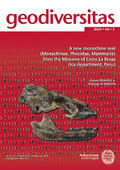
[en] In the present study, we present a new monachine phocid, Magophoca brevirostris n. gen., n. sp., the fifth monachine described from the Pisco Formation (Peru). Coming from the Cerro la Bruja level at the locality of the same name, Magophoca n. gen. is the geologically oldest known seal from the Neogene of the southeast Pacific, dated at least to the late Tortonian, c. 8.4 Ma. Magophoca n. gen. is the second Monachinae (with Noriphoca gaudini) found to possess six upper incisors instead of four as in the other members of the sub-family. Further characters, such as the deep fossa for the m. triceps brachii caput mediale below the humeral head, on the posterior aspect of the proximal extremity of the diaphysis of the humerus, strongly support close relationships with Piscophoca from the latest Miocene and earliest Pliocene of the Pisco Formation at Sud Sacaco (Peru), but more interestingly, with Frisiphoca aberrata from the Tortonian of Belgium. In addition, the presence of an entepicondylar foramen is shared between Frisiphoca and Magophoca n. gen., but rare among other Monachinae, further strengthening the link between both. Although the fossil record of Frisiphoca aberrata is too incomplete to draw conclusions, these marked similarities allow us to hypothesize a dispersal link between both regions, across the late Miocene North Atlantic and Central American Seaway. The phylogenetic analysis retrieved Magophoca n. gen. as closely related to Hadrokirus and Piscophoca from younger levels in the Pisco Formation. This phylogenetic analysis also returned Kawas from the Miocene of Argentina as a sister genus of Homiphoca from the Pliocene of South Africa, thus radically departing from the previous classification of Kawas as a phocine seal.
Title :
A new monachine seal (Monachinae, Phocidae, Mammalia) from the Miocene of Cerro La Bruja (Ica department, Peru)
Funding text :
This study is part of the postdoctoral research project of LD, funded as a Postdoctoral Fellowship by the Fonds national de la Recherche scientifique. The specimens described in this paper have been collected with funds of the MNHN and with the logistic assistance of the IFEA (Institut Français d'Études Andines, Lima, Peru). The specimens have been preprared by Y. Desprès (CR2P-CNRS, MNHN, SU), and N. Durand (MNHN). This study would not have been possible without the valued help of multiple colleagues: A. Folie, curator of fossil collections at the IRSNB, O. Lambert, researcher at the IRSNB, and O. Pauwels, curator of extant collections at the IRSNB, for access to the collections at the IRSNB; G. Billet, curator of vertebrate paleontology at the MNHN, for access to the collections at the MNHN; D. Pol and M. E. Perez (respectively, principal investigator and assistant curator of the fossil mammal collection, CONICET, Museo Paleontológico "Egidio Feruglio", Trelew, Chubut, Argentina) for their assistance in providing casts of several elements of the holotype of Kawas benegasorum; M.R. McGowen, curator of marine mammals at the USNM, D. Lunde, curator of mammals at the USNM, and J.J. Ososky, museum specialist at the USNM, for access to the collections at the USNM. L. Cazes and Ph. Loubry, (CR2P – CNRS, MNHN, SU), for photographing the specimens pictured in this study. Lastly, we wish to thank the editor, E. Côtez, and the reviewers, M. Churchill, and J. P. Rule, for their helpful insights to improve this study. This study is part of the postdoctoral research project of LD, funded as a Postdoctoral Fellowship by the Fonds national de la Recherche scientifique.
Scopus citations®
without self-citations
4