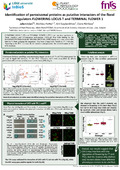
[en] FLOWERING LOCUS T (FT) and TERMINAL FLOWER 1 (TFL1) are two key regulators of floral transition and inflorescence architecture. Although they both belong to the PHOSPHATIDYLETHANOLAMINE BINDING PROTEINS (PEBP) family and share about 60% identity in their polypeptide sequence, they have antagonistic functions: FT promotes flowering while TFL1 represses floral transition and prevents the determination of the inflorescence. In order to identify regulatory mechanisms that contribute to their functional antagonism, we used affinity purification coupled with mass spectrometry (AP-MS) to identify new protein interactors of FT and TFL1. The experiments were carried out with Arabidopsis thaliana seedlings over-expressing tagged versions of FT or TFL1. Surprisingly, we co-purified several peroxisomal proteins as potential interactors of TFL1. A reverse genetics analysis was then conducted to test the functional relevance of these proteins in the regulation of flowering. Among all mutants tested, we found that cat2-3, a mutant in the CATALASE2 (CAT2) gene, was late flowering in short days, but this phenotype was much weaker in other cat2 alleles (cat2-1 and cat2-2). Bimolecular fluorescence complementation (BiFC) and yeast two-hybrid (Y2H) assays were performed and indicate that CAT2 could physically interact with TFL1 and FT. These results suggest that CAT2 may interfere with the regulation of flowering.