Abstract :
[en] Introduction
Clinical metabolomics, analysis of small biologically relevant molecules, is rapidly gaining importance in laboratory medicine due to its diagnostic and prognostic potential. However, optimizing pre-analytical steps remains a major challenge, particularly to meet ISO 15189 standards. This study investigates metabolome stability across various blood matrices, accounting for transport, handling delays, and centrifugation conditions. These preliminary findings aim to inform future robust studies and provide a possible requirement for integration of metabolomics into clinical practice, regarding laboratory quality standards.
Materials and Methods
Metabolomic stability was initially assessed in four blood matrices (serum, EDTA plasma, heparin plasma, fluoride plasma) collected from four voluntary donors. Using NMR spectroscopy, metabolites quantification was measured over two time points: immediate centrifugation versus four hours post-collection. The most stable matrix was selected for further analysis with samples from four additional healthy donors. These samples were subjected to several conditions: Tubes centrifuged immediately, stored at 4°C or 20°C, and frozen at -80°C after 0, 4, or 24 hours. Tubes stored uncentrifuged at 4°C or 20°C for 1, 4, or 24 hours before centrifugation and freezing. Statistical analyses, including PCA, PLS-DA, and one-way repeated ANOVA, were conducted to interpret metabolite stability.
Results
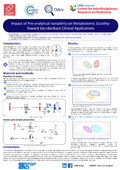
PCA analysis excluded outliers, while PLS-DA confirmed group discrimination based on metabolic stability, further supported by one-way repeated ANOVA. Serum exhibited superior stability across a greater number of metabolites compared to plasma matrices. In the detailed analysis, serum samples subjected to immediate centrifugation preserved metabolites most effectively. Immediate centrifugation emerged as a critical factor for minimizing metabolic variation. When immediate processing was not feasible, storing samples at 4°C significantly outperformed storage at room temperature.
Conclusion
This preliminary study highlights the substantial influence of pre-analytical conditions on metabolite stability. Serum proved to be the optimal matrix for preserving the blood metabolome in medical biology compared to plasma. These findings offer pre requirement to establish practical guidance for the standardization of blood sample collection and processing in metabolomic research. By establishing robust pre-analytical protocols, this approach could help to integrate metabolomics into routine clinical practice, in order to use it for personalized diagnostics and therapeutic monitoring.