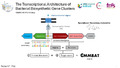
[en] Bacteria produce a diverse array of specialized bioactive metabolites with crucial ecological roles and pharmaceutical applications. These compounds are synthesized by biosynthetic gene clusters (BGCs), whose expression is tightly regulated. While many studies have examined the factors influencing BGC expression, including transcription factors (TFs) and environmental signals, the precise regulatory mechanisms remain largely unexplored. In this review, we analyzed experimental datasets of transcription factor binding sites (TFBSs) across 17 bacterial genera to explore the regulatory architecture governing BGCs expression; focusing on i) the functional gene categories preferentially targeted by TFs, ii) the regulatory coverage based on cluster organization, iii) the positional distribution of TFBSs, and iv) the binding strength of TFs. Our findings reveal a regulatory strategy where global TFs primarily target pathway-specific TFs when present, aligning with a "one-for-all" strategy ensuring cluster-wide expression control. Additionally, we examined the organization of TFBS-associated genes, identifying distinct transcriptional strategies: regulatory genes are frequently monocistronic, while biosynthetic genes tend to be co-transcribed in operons to optimize biosynthesis efficiency. The positional distribution of TFBSs highlights a strong enrichment in the upstream regulatory regions of genes optimizing their role in gene activation and repression. Finally, assessment of TF-TFBS interaction strength suggests that the cis-elements within BGCs exhibit lower binding affinities compared to those associated with core regulon genes that reside outside BGCs, likely allowing greater regulatory flexibility in response to multiple environmental cues. These findings provide new insights into the regulatory principles shaping BGC expression to environmental cues and would help predict conditions for activating cryptic BGCs, facilitating the discovery of novel bioactive compounds through targeted culture and engineering strategies.
Disciplines :
Microbiology
Author, co-author :
Ribeiro Monteiro, Silvia ; Université de Liège - ULiège > Département des sciences de la vie > Centre d'Ingénierie des Protéines (CIP)
Kerdel, Yasmine ; Université de Liège - ULiège > Département des sciences de la vie > Centre d'Ingénierie des Protéines (CIP)