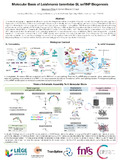
[en] Kinetoplastids are a group of flagellated, unicellular eukaryotes that diverged very early in the evolution. This phylum contains two lineages of parasitic organisms, Trypanosoma and Leishmania, which cause several tropical diseases such as sleeping sickness, Chagas disease, and various forms of leishmaniasis. Unlike other organisms, Kinetoplastids have a completely divergent mechanism of gene transcription and regulation. RNA Polymerase II (Pol II) randomly transcribes long polycistronic pre-mRNAs containing 10-100 coding sequences (CDSs). These pre-mRNAs are then processed into monocistronic mRNA via SL trans-splicing where a splice leader RNA (SL RNA), an invariant small nuclear RNA (snRNA) is added to 5' end all mRNAs. The SL RNA assembles with other proteins to form the SL snRNP, which plays a central role in the cell as both an architectural component of the trans-spliceosome and as the substrate of the SL trans-splicing reaction. Despite its importance, the composition and assembly of the SL snRNP is poorly understood due to the lack of structural data. Only a few proteins have been identified as assembly or maturation factors, and the overall biogenesis pathway remains largely unknown. In this PhD project, my goal is to reveal the atomic details of SL snRNP biogenesis pathway prior its recrutement into the trans-spliceosme using genome editing and cryo-electron microscopy.
Research Center/Unit :
CIP - Centre d'Ingénierie des Protéines - ULiège
Disciplines :
Biochemistry, biophysics & molecular biology
Author, co-author :
Nadenoen, Théo ; Université de Liège - ULiège > Département des sciences de la vie > Centre d'Ingénierie des Protéines (CIP)
Vanden Broeck, Arnaud ; Université de Liège - ULiège > Département des sciences de la vie > Centre d'Ingénierie des Protéines (CIP)
Language :
English
Title :
Molecular Basis of Leishmania tarentolae SL snRNP Biogenesis