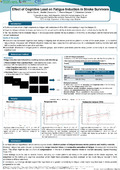
[en] Stroke survivors show a high propensity to fatigue. This fatigue is known to impact negatively performance , as well as the ability of stroke survivors to return to their day-to-day life . Yet, few studies examined induction of cognitive fatigue in stroke beyond the acute phase (> 6 months), leaving its mechanisms poorly understood. 29 stroke patients and 25 healthy controls first underwent a fatigue inducing task in either a high cognitive load (HCL) or a low cognitive load condition (LCL) using the x-Time Load Dual Back task. Following the fatigue induction task, a working memory task (Sternberg, set size from 2 to 7) was administered, along with visual analog scales of fatigue pre- and post-task. GLMMs were applied on (1) behavioural performance (accuracy and response time) at the Sternberg task and (2) subjective measure of fatigue (VAS-f). GLMMs included group (stroke, control), fatigue induction condition (HCL, LCL), as well as set size (2 to 7) for behavioural performance and time (pre-, post-task) for VAS-f. We observed slower reaction times (p < .001) and higher subjective fatigue (p < .001) in the HCL condition. We also observed an increase of subjective fatigue over time (p < .001), with no difference between groups (Stroke, controls) across all measures. Stroke survivors did not exhibit greater fatigue vulnerability under high cognitive load compared to controls. This challenges the assumption of higher propensity to cognitive fatigue in post-acute stroke, suggesting that other factors may contribute to their experience.
Research Center/Unit :
GIGA CRC (Cyclotron Research Center) In vivo Imaging-Aging & Memory - ULiège
Disciplines :
Neurosciences & behavior
Author, co-author :
David, Martin ; Université de Liège - ULiège > Faculté de Psychologie, Logopédie et Sciences de l'Education > Master sc. psycho., fin. spéc.