nonlinear system identification; resonance; experimental continuation; broadband
Abstract :
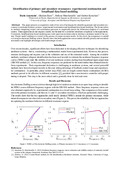
[en] This paper presents a comparative study of two sets of techniques for identifying primary and secondary resonances in nonlinear dynamic systems: experimental continuation and broadband data-based modeling. The former refers to methods integrating control and continuation processes to empirically derive the bifurcation diagram of a nonlinear system. These approaches do not require a model, but the need for a controller introduces complexity in the experiments. Conversely, broadband data-based modeling uses wide-spectrum excitation data to develop a nonlinear model of the system. Proper model validation is crucial in this process to ensure accurate results. In this work, the comparison is carried out using an electronic Duffing system. Results show that both approaches can accurately identify primary and secondary resonances and highlight advantages and disadvantages of each.