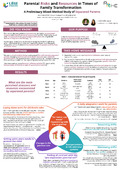
Abstract :
[en] Parental separation brings significant changes within the family system, which may
increase the risk of stress accumulation and resource depletion for both parents and children. According to the Balance between Risks and Resources framework, parents facing heightened stress are more vulnerable to adverse mental health outcomes, such as parental burnout - a chronic stress syndrome experienced in the parental role. While previous studies have documented parental burnout across different family structures (e.g., two-parent, single-parent, and blended families), no study has explored specific risks and resources experienced by separated parents, despite evidence that separation can impose significant short- and long-term challenges to the parental role. This study presents a thematic analysis of the subjective parenting experiences of five separated parents, integrating qualitative data from semi-structured interviews with validated quantitative measures of parental well-being. Results reveal that while parents typically face an intensification of stressors shortly after separation, some persist longterm. Key themes include coparenting dynamics (e.g. cooperation challenges, conflicts), shifts in parental identity and responsibility (e.g., overinvestment, loss, contrast in parental role), and contextual factors (e.g., changes in social networks, family reorganization, repartnering). Resources, such as strong social support, emerged as key facilitators of parental adjustment. These results provide a nuanced understanding of the stressors and resources encountered by separated parents, highlighting essential areas for further research and informing interventions aimed at supporting parental well-being post-separation.