Keywords :
Radiotherapy, sdAb, alpha-therapy, multiple myeloma
Abstract :
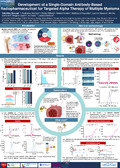
[en] Introduction: Multiple myeloma (MM) is a blood cancer where malignant plasma cells accumulate in the bone marrow. Initial treatments reduce tumor cells but do not eliminate them entirely, often leading to relapses. The CD38 protein, highly expressed in myeloma cells, can be targeted with theranostic agents: compounds that allow for diagnosis and treatment. This study presents a theranostic approach using a radiolabeled single-domain antibody (sdAb) targeting CD38, called 2F8, developed in our laboratory(1). This can enable both early detection of cancer and implementation of target therapy based on α-emitter radionuclides (TAT)(2). Methods: The diagnostic potential of 2F8 was previously investigated. For therapeutic applications, the 2F8 sdAb was conjugated with p-SCN-Bn-DOTA (20 equivalents) allowing the labeling with the therapeutic radiometals 225Ac(α-emitter) and 177Lu (β-emitter). These two radionuclides were compared to assess the advantages of using alpha radiation over beta radiation. The radiochemical purity (RCP) of each compound was assessed using radio-iTLC and radio-SEC. The stability over time was evaluated by incubating in human serum. Binding and internalization in CD38+ RPMI tumor cells were measured by γ-counting, with parallel experiments performed using non-radiolabeled 2F8 to block binding for a comparative analysis. Results/discussion: the conjugation of the DOTA-vector resulted in an average of 1.8 DOTA molecules per sdAb. Starting the labelling with 100 kBq of 225Ac and 200 MBq of 177Lu, we achieved an RCP of over 97% after 30 min and 45 min of incubation, respectively. In human serum, no free radionuclide was detached from the sdAb, with an RCP greater than 90% for both radionuclides after 24 hours, confirming the compound's stability validating the use for the in vivo. The radiopharmaceutical binding capacity to the CD38 antigen showed that the affinity was retained. Moreover, the internalization by cells was studied measuring the retained radioactivity after 24h, the radiolabeled 2F8 showing poor internalization. Preclinical studies with [225Ac]Ac-DOTA-2F8 will be conducted and compared to its 177Lu-labelled analogue to investigate the potential advantages of TAT. Conclusions: The sdAb 2F8 can be successfully labelled with 225Ac, maintaining its ability to bind to CD38-expressing MM cells. Coupling the high cytotoxicity of alpha particles with the specificity of sdAb 2F8 makes as a promising therapeutic tool for future applications. Prospectively, this radiopharmaceutical could be for treating minimal residual disease in MM, potentially reducing the risk of relapse.
Novelty: This is the first time a CD38-targeting sdAb has been labeled with 225Ac for TAT in hematological tumors. Currently, few TAT exist for MM, so we are investigating the potential of 2F8.
Impact: this study provides a new theranostic tool that combines diagnosis and therapy to improve MM treatment and reduce relapse risk.
1. Duray E, Lejeune M, Baron F, Beguin Y, Devoogdt N, Krasniqi A, et al. A non-internalised CD38-binding radiolabelled single-domain antibody fragment to monitor and treat multiple myeloma. J Hematol Oncol. 2021 Nov;14(1):183.
2. D’Huyvetter M, Xavier C, Caveliers V, Lahoutte T, Muyldermans S, Devoogdt N. Radiolabeled nanobodies as theranostic tools in targeted radionuclide therapy of cancer. Expert Opin Drug Deliv. 2014 Dec;11(12):1939–54.