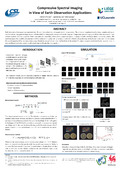
[en] Earth observation from space is an important scientific and industrial activity, having applications in many sectors. The instruments employed are often large, complex, and expensive. In addition, they generate large amounts of data which is challenging for storage and transfer purposes. Compressive spectral imaging would be a cheaper, more efficient,
and well-adapted technique to perform Earth observation. An interesting architecture is compressive spectral imaging with diffractive lenses which is extremely compact. This
work investigates the possibility of replacing the diffractive lens in this system with a classical refractive lens. Indeed, taking advantage of the chromatic aberration of a lens makes the use of expensive diffractive lenses unnecessary. Simulations are performed to test the feasibility of the method. The signal recovery is performed by the resolution of an inverse
problem, in particular, a basis pursuit solved using the Douglas-Rashford algorithm.
Disciplines :
Space science, astronomy & astrophysics
Author, co-author :
Thomas, Clément ; Université de Liège - ULiège > Centres généraux > CSL (Centre Spatial de Liège)
Jacques, Laurent; UCL - Université Catholique de Louvain > ICTEAM Institute > Image and Signal Processing Group
Georges, Marc ; Université de Liège - ULiège > Centres généraux > CSL (Centre Spatial de Liège)
Language :
English
Title :
Compressive Spectral Imaging in View of Earth Observation Applications - Poster
Publication date :
07 February 2025
Event name :
PhD Day Space4Relaunch 2025
Event date :
07/02/2025
By request :
Yes
Name of the research project :
Space4Relaunch
Funders :
SPW EER - Service Public de Wallonie. Economie, Emploi, Recherche