Abstract :
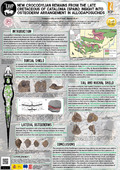
[en] Osteoderms are bony structures commonly found in the dermal layer of the skin of various animals, including crocodylians, whose osteoderms are abundant in the fossil record. In crocodyliforms, osteoderms are often arranged in regular patterns, which can provide valuable insights into their evolutionary history, behavior, and ecology. However, determining the arrangement of osteoderms in extinct crocodyliform groups has been challenging due to the limited number of cases where the osteoderms of a single specimen are found in anatomical connection. Here, we analyze more than 70 dorsal osteoderms from the allodaposuchid specimen found at the Fontllonga-6 fossil site (Àger Basin, NE Spain), in the lower red unit of the Tremp Formation (early–-late Maastrichtian). All recovered osteoderms exhibit a single keel, the ridge and pit pattern commonly associated with crocodyliforms, and diverse size and shape, which provides information about the position of these elements in the dermal skeleton. Allodaposuchids possess a tetraserial paravertebral shield with large, flat, and low-keeled osteoderms that have thick lateral and medial sutures to connect each osteoderm along the transverse row. While the exact number of accessory parasagittal rows cannot be determined, several accessory osteoderms and nuchal shield osteoderms have been recovered, including both low-keeled and very high-keeled osteoderms. Generally, the relative size and shape of the osteoderms resemble those of alligators, suggesting a similar osteoderm pattern. The study sheds light on the poorly documented dermal skeleton of allodaposuchids, providing new insight into the evolutionary history and ecology of crocodyliforms in the Late Cretaceous of Europe.
Disciplines :
Earth sciences & physical geography
Physical, chemical, mathematical & earth Sciences: Multidisciplinary, general & others