No document available.
Abstract :
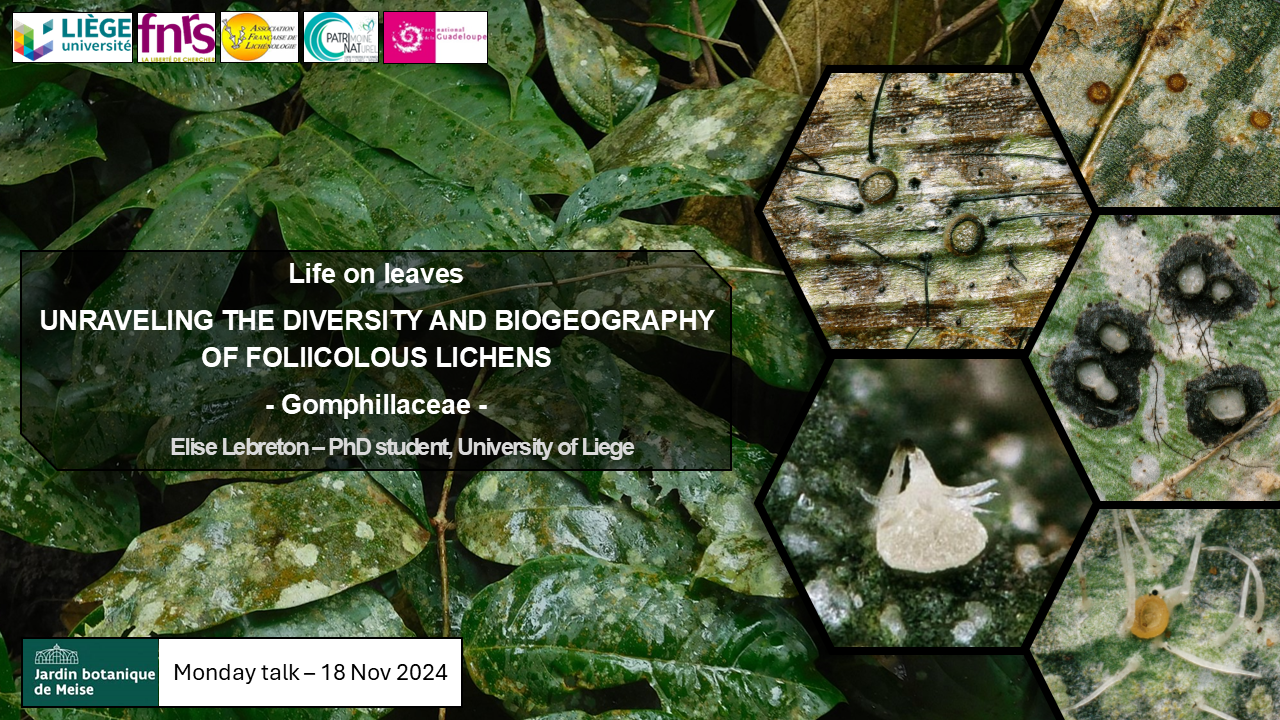
[en] Found in all terrestrial ecosystems, lichens are the result of a symbiosis between a fungus and an alga and/or a cyanobacteria. Lichens are known to grow on various substrates such as rocks, tree bark and soil. In tropical and subtropical environments, colonisation on tree leaves, known as "foliicolous", is an atypical and poorly understood lifestyle for the lichens. Alongside bryophytes, algae, cyanobacteria, fungi, bacteria, and invertebrates, they form the phyllosphere, a miniature ecosystem best developed in tropical rainforests. A large part of foliicolous lichens belong to the Gomphillaceae family, the most diverse group of leaf-dwelling lichenized fungi. Many phenotype-based species in this family are considered as pantropical or even sub-cosmopolitan, either attributed to old ages, having existed prior to continental breakups, or long-distance dispersal. Our overarching goal is to reconstruct the phylogeny and biogeography of the Gomphillaceae to test whether its species fit the pantropical to cosmopolitan species concept or if those rather represent complexes of species with more restricted distribution. Our sampling encompassed six major biodiversity hotspots: MIOI (Madagascar and the Indian Ocean Islands), the Caribbean, New Caledonia, the Colombian Chocó, Mesoamerica, and the Atlantic coast of Brazil. The global phylogeny was based on multilocus sequence data (mtSSU rDNA, nuLSU rDNA, and RPB1), including 2197 sequences of 1265 specimens. We applied an integrative taxonomy approach, including detailed phenotypical observations, phylogenetic and species delimitation analyses. Our phylogeny includes approximately 473 species, of which 104 are confirmed as described, 213 are classified as cryptic or near cryptic (hidden diversity), 100 represent new species to science (identified on the basis of phenotype) and 56 remain unidentified. Our results challenge previous beliefs, revealing more restricted distributions in phylogenetic species compared to morphospecies. These findings suggest a higher level of endemism and a greater degree of cryptic speciation than was previously recognized in foliicolous lichens.
Name of the research project :
Lebreton E, Ertz D, Lücking R, Aptroot A, Carriconde F, Ah-Peng C, Huang J-P, Chen K-H, Stenger P-L, Cáceres MES, van den Boom P, Sérusiaux E, Magain N (2025) Global phylogeny of the family Gomphillaceae (Ascomycota, Graphidales) sheds light on the origin, diversification and endemism in foliicolous lineages. IMA Fungus 16: e144194.