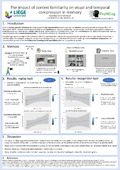
[en] In our daily life, we experience an immensely rich flow of information that we segment into meaningful events. However, our memory is limited and cannot store all these perceptual information. To enable efficient remembering, our cognitive system must compress visuo-spatial and temporal content into memory. Recent studies indicate that spatio-temporal compression could be influenced by the contextual familiarity an event takes place in (Bonasia et al., 2016; Jafarpour & Spiers, 2016). Resource-based theories (Bellana et al., 2021) and construct-based hypotheses of memory (Robin & Moscovitch, 2014) suggest that established representation in memory should release resources to be allocated for the encoding of new details while accelerating the recall of the episode. On the other hand, schema-based theories suggest only a robust encoding for the central elements with a reduced memory for idiosyncratic details (Gilboa & Marlatte, 2017). Our experiment challenges these hypotheses in an ecological setting by testing the memory of first-year students on their recorded campus tour. At the first session, participants took a walk on the campus during which they crossed familiar and unfamiliar places. Then, they were asked to return to the lab to be tested on their memory of the tour. First, we measured the duration they took to mentally relive each segment of their walk. Then, we asked them to recall it orally in as much detail as possible. After that, they went through a forced-choice recognition task where they had to pick images of their tour rather than the ones from other participants. Finally, they had to segment their walk into meaningful events and assign a rating of familiarity to each part. We will present preliminary data testing these theories, with the prediction that participants will produce more detailed report, better accuracy and faster recall for segments experienced in a familiar place.
Research Center/Unit :
PsyNCog - Psychologie et Neuroscience Cognitives - ULiège
Disciplines :
Theoretical & cognitive psychology
Author, co-author :
Nguy, Kévin ; Université de Liège - ULiège > Psychologie et Neuroscience Cognitives (PsyNCog)
Devue, Christel ; Université de Liège - ULiège > Département de Psychologie > Psychologie et neurosciences cognitives
Language :
English
Title :
The impact of context familiarity on visual and temporal compression in memory
Alternative titles :
[fr] L'impact de la familirité du contexte sur la compression visuelle et temporelle en mémoire
Publication date :
15 April 2025
Event name :
Cognitive Neuroscience of Memory: The Recollection, Familiarity, and Novelty Detection conference (RFN2025)
Event organizer :
Christine Bastin & Olivier Luminet
Event place :
Liège, Belgium
Event date :
15/04/2025 - 16/04/2025
Audience :
International
Name of the research project :
COMPRESS – Spatio-temporal compression in memory for real-world events