habitat use; wild reindeer; resource selection function
Abstract :
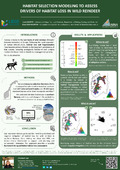
[en] Terrestrial biodiversity is declining rapidly from human land uses and associated landscape changes. In Norway, fast-paced anthropogenic development threatens Europe’s last wild reindeer (Rangifer tarandus tarandus) herds hosted in southern country, which are primarily impacted by consequent habitat loss and fragmentation. In order to help land management towards the protection of suitable and ecologically functional habitats for the species, we developed a quantitative and spatially-explicit framework based on resource selection functions (RSFs) to assess the main drivers of habitat loss. Our results revealed substantial habitat loss (> 50%) in most herds, with major drivers of habitat loss being unevenly distributed within the study area. Overall, highest disturbance levels were caused by grazing animals from domestic livestock, houses, roads and hiking trails. These results point out the need for prioritized and targeted mitigation of herd-specific drivers of habitat loss, and provide key insights for preventing future human-reindeer conflicts. More widely, we show that RSFs can deliver timely information and practical support to land management and conservation strategies. Our approach provides a valuable framework for assessing habitat loss, scalable to many other biodiversity components, and thus offers potential to address this leading cause of species extinction worldwide.