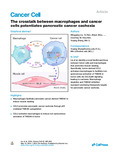
[en] With limited treatment options, cachexia remains a major challenge for patients with cancer. Characterizing the interplay between tumor cells and the immune microenvironment may help identify potential therapeutic targets for cancer cachexia. Herein, we investigate the critical role of macrophages in potentiating pancreatic cancer induced muscle wasting via promoting TWEAK (TNF-like weak inducer of apoptosis) secretion from the tumor. Specifically, depletion of macrophages reverses muscle degradation induced by tumor cells. Macrophages induce non-autonomous secretion of TWEAK through CCL5/TRAF6/NF-κB pathway. TWEAK promotes muscle atrophy by activating MuRF1 initiated muscle remodeling. Notably, tumor cells recruit and reprogram macrophages via the CCL2/CCR2 axis and disrupting the interplay between macrophages and tumor cells attenuates muscle wasting. Collectively, this study identifies a feedforward loop between pancreatic cancer cells and macrophages, underlying the non-autonomous activation of TWEAK secretion from tumor cells thereby providing promising therapeutic targets for pancreatic cancer cachexia.
Disciplines :
Biochemistry, biophysics & molecular biology
Author, co-author :
Liu, Mingyang ✱; Department of Medicine, The University of Oklahoma Health Sciences Center, Oklahoma City, OK 73104, USA, Department of Surgery, The University of Oklahoma Health Sciences Center, Oklahoma City, OK 73104, USA
Ren, Yu ✱; Department of Medicine, The University of Oklahoma Health Sciences Center, Oklahoma City, OK 73104, USA, Department of Surgery, The University of Oklahoma Health Sciences Center, Oklahoma City, OK 73104, USA
Zhou, Zhijun ✱; Department of Medicine, The University of Oklahoma Health Sciences Center, Oklahoma City, OK 73104, USA, Department of Surgery, The University of Oklahoma Health Sciences Center, Oklahoma City, OK 73104, USA
Yang, Jingxuan ✱; Department of Medicine, The University of Oklahoma Health Sciences Center, Oklahoma City, OK 73104, USA, Department of Surgery, The University of Oklahoma Health Sciences Center, Oklahoma City, OK 73104, USA
Shi, Xiuhui ✱; Université de Liège - ULiège > Département de pharmacie ; Department of Medicine, The University of Oklahoma Health Sciences Center, Oklahoma City, OK 73104, USA, Department of Surgery, The University of Oklahoma Health Sciences Center, Oklahoma City, OK 73104, USA
Cai, Yang ✱; Department of Medicine, The University of Oklahoma Health Sciences Center, Oklahoma City, OK 73104, USA, Department of Surgery, The University of Oklahoma Health Sciences Center, Oklahoma City, OK 73104, USA
Arreola, Alex X; Department of Medicine, The University of Oklahoma Health Sciences Center, Oklahoma City, OK 73104, USA, Department of Pathology, The University of Oklahoma Health Sciences Center, Oklahoma City, OK 73104, USA
Luo, Wenyi; Department of Pathology, Yale School of Medicine, New Haven, CT 06519, USA
Fung, Kar-Ming; Department of Pathology, The University of Oklahoma Health Sciences Center, Oklahoma City, OK 73104, USA
Xu, Chao; Department of Biostatistics and Epidemiology, Hudson College of Public Health, The University of Oklahoma Health Sciences Center, Oklahoma City, OK 73104, USA
Nipp, Ryan D; Department of Medicine, The University of Oklahoma Health Sciences Center, Oklahoma City, OK 73104, USA
Bronze, Michael S; Department of Medicine, The University of Oklahoma Health Sciences Center, Oklahoma City, OK 73104, USA
Zheng, Lei; Sidney Kimmel Comprehensive Cancer Center, Johns Hopkins University School of Medicine, Baltimore, MD 21287, USA
Li, Yi-Ping; Department of Integrative Biology & Pharmacology, The University of Texas Health Science Center at Houston, Houston, TX 77030, USA
Houchen, Courtney W; Department of Medicine, The University of Oklahoma Health Sciences Center, Oklahoma City, OK 73104, USA
Zhang, Yuqing ✱; Department of Medicine, The University of Oklahoma Health Sciences Center, Oklahoma City, OK 73104, USA, Department of Surgery, The University of Oklahoma Health Sciences Center, Oklahoma City, OK 73104, USA. Electronic address: Yuqing-Zhang@ouhsc.edu
Li, Min ✱; Department of Medicine, The University of Oklahoma Health Sciences Center, Oklahoma City, OK 73104, USA, Department of Surgery, The University of Oklahoma Health Sciences Center, Oklahoma City, OK 73104, USA. Electronic address: Min-Li@ouhsc.edu
William and Ella Owens Medical Research Foundation VCU - Virginia Commonwealth University NIH - National Institutes of Health
Funding text :
This work was supported in part by the National Institutes of Health National Cancer Institute grants R01 CA186338, R01 CA203108, R01 CA247234, and award P30 CA225520, and by the William and Ella Owens Medical Research Foundation (M. Li). The PDX cell lines derived from pancreatic cancer patients with cachexia were established by Dr. Jose Trevino from Virginia Commonwealth University. Study conception and design: M.Liu, Y.R. Z.Z. J.Y. X.S. Y.Z. and M.Li. Data curation: M.Liu, Y.R. Z.Z. J.Y. Y.C. and X.S. Formal analysis: M.Liu, Y.R. Z.Z. J.Y. X.S. Y.C. C.X. K.F. A.A. and W.L. Visualization: M.Liu, Y.R. Z.Z. and J.Y. Resources: M.B. Y.Z. L.Z. C.H. Y.L. and M.Li. Funding acquisition: M.Li. Writing \u2013 original drafts: M.Liu, Y.R. and Z.Z. Writing \u2013 review and editing: M.Liu, Y.R. Z.Z. J.Y. X.S. R.N. A.A. M.B. Y.L. L.Z. C.H. Y.Z. and M.Li. Supervision: Y.Z. and M.Li. C.W. Houchen has ownership interest in COARE Holdings Inc.This work was supported in part by the National Institutes of Health National Cancer Institute grants R01 CA186338 , R01 CA203108 , R01 CA247234 , and award P30 CA225520 , and by the William and Ella Owens Medical Research Foundation (M. Li). The PDX cell lines derived from pancreatic cancer patients with cachexia were established by Dr. Jose Trevino from Virginia Commonwealth University.
Siegel, R.L., Miller, K.D., Wagle, N.S., Jemal, A., Cancer statistics, 2023. CA. Cancer J. Clin. 73 (2023), 17–48, 10.3322/caac.21763.
Rahib, L., Wehner, M.R., Matrisian, L.M., Nead, K.T., Estimated Projection of US Cancer Incidence and Death to 2040. JAMA Netw. Open, 4, 2021, e214708, 10.1001/jamanetworkopen.2021.4708.
Pryce, B.R., Wang, D.J., Zimmers, T.A., Ostrowski, M.C., Guttridge, D.C., Cancer cachexia: involvement of an expanding macroenvironment. Cancer Cell 41 (2023), 581–584, 10.1016/j.ccell.2023.02.007.
Fearon, K., Strasser, F., Anker, S.D., Bosaeus, I., Bruera, E., Fainsinger, R.L., Jatoi, A., Loprinzi, C., MacDonald, N., Mantovani, G., et al. Definition and classification of cancer cachexia: an international consensus. Lancet Oncol. 12 (2011), 489–495, 10.1016/S1470-2045(10)70218-7.
Roeland, E.J., Bohlke, K., Baracos, V.E., Bruera, E., Del Fabbro, E., Dixon, S., Fallon, M., Herrstedt, J., Lau, H., Platek, M., et al. Management of Cancer Cachexia: ASCO Guideline. J. Clin. Oncol. 38 (2020), 2438–2453, 10.1200/JCO.20.00611.
Hosein, A.N., Brekken, R.A., Maitra, A., Pancreatic cancer stroma: an update on therapeutic targeting strategies. Nat. Rev. Gastroenterol. Hepatol. 17 (2020), 487–505, 10.1038/s41575-020-0300-1.
Huang, H., Wang, Z., Zhang, Y., Pradhan, R.N., Ganguly, D., Chandra, R., Murimwa, G., Wright, S., Gu, X., Maddipati, R., et al. Mesothelial cell-derived antigen-presenting cancer-associated fibroblasts induce expansion of regulatory T cells in pancreatic cancer. Cancer Cell 40 (2022), 656–673.e7, 10.1016/j.ccell.2022.04.011.
Zhou, Z., Xia, G., Xiang, Z., Liu, M., Wei, Z., Yan, J., Chen, W., Zhu, J., Awasthi, N., Sun, X., et al. A C-X-C Chemokine Receptor Type 2-Dominated Cross-talk between Tumor Cells and Macrophages Drives Gastric Cancer Metastasis. Clin. Cancer Res. 25 (2019), 3317–3328, 10.1158/1078-0432.CCR-18-3567.
Lee, B.Y., Hogg, E.K.J., Below, C.R., Kononov, A., Blanco-Gomez, A., Heider, F., Xu, J., Hutton, C., Zhang, X., Scheidt, T., et al. Heterocellular OSM-OSMR signalling reprograms fibroblasts to promote pancreatic cancer growth and metastasis. Nat. Commun., 12, 2021, 7336, 10.1038/s41467-021-27607-8.
Pucci, F., Coussens, L.M., Redirecting tumor macrophage activity to fight cancer: Make room for the next era of anti-cancer drugs. Cancer Cell 39 (2021), 1300–1302, 10.1016/j.ccell.2021.09.009.
Madaro, L., Passafaro, M., Sala, D., Etxaniz, U., Lugarini, F., Proietti, D., Alfonsi, M.V., Nicoletti, C., Gatto, S., De Bardi, M., et al. Denervation-activated STAT3-IL-6 signalling in fibro-adipogenic progenitors promotes myofibres atrophy and fibrosis. Nat. Cell Biol. 20 (2018), 917–927, 10.1038/s41556-018-0151-y.
Carr, R.M., Fernandez-Zapico, M.E., It Takes a Village to Overcome KRAS Dependence in Pancreatic Cancer. Cancer Discov. 10 (2020), 910–912, 10.1158/2159-8290.CD-20-0490.
Hou, P., Kapoor, A., Zhang, Q., Li, J., Wu, C.J., Li, J., Lan, Z., Tang, M., Ma, X., Ackroyd, J.J., et al. Tumor Microenvironment Remodeling Enables Bypass of Oncogenic KRAS Dependency in Pancreatic Cancer. Cancer Discov. 10 (2020), 1058–1077, 10.1158/2159-8290.CD-19-0597.
Talbert, E.E., Lewis, H.L., Farren, M.R., Ramsey, M.L., Chakedis, J.M., Rajasekera, P., Haverick, E., Sarna, A., Bloomston, M., Pawlik, T.M., et al. Circulating monocyte chemoattractant protein-1 (MCP-1) is associated with cachexia in treatment-naive pancreatic cancer patients. J. Cachexia Sarcopenia Muscle 9 (2018), 358–368, 10.1002/jcsm.12251.
Petruzzelli, M., Wagner, E.F., Mechanisms of metabolic dysfunction in cancer-associated cachexia. Genes Dev. 30 (2016), 489–501, 10.1101/gad.276733.115.
Argilés, J.M., Stemmler, B., López-Soriano, F.J., Busquets, S., Inter-tissue communication in cancer cachexia. Nat. Rev. Endocrinol. 15 (2018), 9–20, 10.1038/s41574-018-0123-0.
Poulia, K.A., Sarantis, P., Antoniadou, D., Koustas, E., Papadimitropoulou, A., Papavassiliou, A.G., Karamouzis, M.V., Pancreatic Cancer and Cachexia-Metabolic Mechanisms and Novel Insights. Nutrients, 12, 2020, 1543, 10.3390/nu12061543.
Hou, Y.C., Wang, C.J., Chao, Y.J., Chen, H.Y., Wang, H.C., Tung, H.L., Lin, J.T., Shan, Y.S., Elevated Serum Interleukin-8 Level Correlates with Cancer-Related Cachexia and Sarcopenia: An Indicator for Pancreatic Cancer Outcomes. J. Clin. Med., 7, 2018, 502, 10.3390/jcm7120502.
Tan, C.R., Yaffee, P.M., Jamil, L.H., Lo, S.K., Nissen, N., Pandol, S.J., Tuli, R., Hendifar, A.E., Pancreatic cancer cachexia: a review of mechanisms and therapeutics. Front. Physiol., 5, 2014, 88, 10.3389/fphys.2014.00088.
Shi, X., Yang, J., Liu, M., Zhang, Y., Zhou, Z., Luo, W., Fung, K.M., Xu, C., Bronze, M.S., Houchen, C.W., Li, M., Circular RNA ANAPC7 Inhibits Tumor Growth and Muscle Wasting via PHLPP2-AKT-TGF-beta Signaling Axis in Pancreatic Cancer. Gastroenterology 162 (2022), 2004–2017.e2, 10.1053/j.gastro.2022.02.017.
Yang, J., Zhang, Z., Zhang, Y., Ni, X., Zhang, G., Cui, X., Liu, M., Xu, C., Zhang, Q., Zhu, H., et al. ZIP4 Promotes Muscle Wasting and Cachexia in Mice With Orthotopic Pancreatic Tumors by Stimulating RAB27B-Regulated Release of Extracellular Vesicles From Cancer Cells. Gastroenterology 156 (2019), 722–734.e6, 10.1053/j.gastro.2018.10.026.
Zhou, Z., Ren, Y., Yang, J., Liu, M., Shi, X., Luo, W., Fung, K.M., Xu, C., Bronze, M.S., Zhang, Y., et al. Acetyl-Coenzyme A Synthetase 2 Potentiates Macropinocytosis and Muscle Wasting Through Metabolic Reprogramming in Pancreatic Cancer. Gastroenterology 163 (2022), 1281–1293.e1, 10.1053/j.gastro.2022.06.058.
Penafuerte, C.A., Gagnon, B., Sirois, J., Murphy, J., MacDonald, N., Tremblay, M.L., Identification of neutrophil-derived proteases and angiotensin II as biomarkers of cancer cachexia. Br. J. Cancer 114 (2016), 680–687, 10.1038/bjc.2016.3.
de Visser, K.E., Joyce, J.A., The evolving tumor microenvironment: From cancer initiation to metastatic outgrowth. Cancer Cell 41 (2023), 374–403, 10.1016/j.ccell.2023.02.016.
Freire, P.P., Fernandez, G.J., de Moraes, D., Cury, S.S., Dal Pai-Silva, M., Dos Reis, P.P., Rogatto, S.R., Carvalho, R.F., The expression landscape of cachexia-inducing factors in human cancers. J. Cachexia Sarcopenia Muscle 11 (2020), 947–961, 10.1002/jcsm.12565.
Cassetta, L., Fragkogianni, S., Sims, A.H., Swierczak, A., Forrester, L.M., Zhang, H., Soong, D.Y.H., Cotechini, T., Anur, P., Lin, E.Y., et al. Human Tumor-Associated Macrophage and Monocyte Transcriptional Landscapes Reveal Cancer-Specific Reprogramming, Biomarkers, and Therapeutic Targets. Cancer Cell 35 (2019), 588–602.e10, 10.1016/j.ccell.2019.02.009.
Queiroz, A.L., Dantas, E., Ramsamooj, S., Murthy, A., Ahmed, M., Zunica, E.R.M., Liang, R.J., Murphy, J., Holman, C.D., Bare, C.J., et al. Blocking ActRIIB and restoring appetite reverses cachexia and improves survival in mice with lung cancer. Nat. Commun., 13, 2022, 4633, 10.1038/s41467-022-32135-0.
Hara, T., Chanoch-Myers, R., Mathewson, N.D., Myskiw, C., Atta, L., Bussema, L., Eichhorn, S.W., Greenwald, A.C., Kinker, G.S., Rodman, C., et al. Interactions between cancer cells and immune cells drive transitions to mesenchymal-like states in glioblastoma. Cancer Cell 39 (2021), 779–792.e11, 10.1016/j.ccell.2021.05.002.
Boring, L., Gosling, J., Chensue, S.W., Kunkel, S.L., Farese, R.V. Jr., Broxmeyer, H.E., Charo, I.F., Impaired monocyte migration and reduced type 1 (Th1) cytokine responses in C-C chemokine receptor 2 knockout mice. J. Clin. Invest. 100 (1997), 2552–2561, 10.1172/JCI119798.
Johnston, A.J., Murphy, K.T., Jenkinson, L., Laine, D., Emmrich, K., Faou, P., Weston, R., Jayatilleke, K.M., Schloegel, J., Talbo, G., et al. Targeting of Fn14 Prevents Cancer-Induced Cachexia and Prolongs Survival. Cell 162 (2015), 1365–1378, 10.1016/j.cell.2015.08.031.
Walens, A., DiMarco, A.V., Lupo, R., Kroger, B.R., Damrauer, J.S., Alvarez, J.V., CCL5 promotes breast cancer recurrence through macrophage recruitment in residual tumors. Elife, 8, 2019, e43653, 10.7554/eLife.43653.
He, W.A., Berardi, E., Cardillo, V.M., Acharyya, S., Aulino, P., Thomas-Ahner, J., Wang, J., Bloomston, M., Muscarella, P., Nau, P., et al. NF-kappaB-mediated Pax7 dysregulation in the muscle microenvironment promotes cancer cachexia. J. Clin. Invest. 123 (2013), 4821–4835, 10.1172/JCI68523.
Xie, C., Zhang, L.Z., Chen, Z.L., Zhong, W.J., Fang, J.H., Zhu, Y., Xiao, M.H., Guo, Z.W., Zhao, N., He, X., Zhuang, S.M., A hMTR4-PDIA3P1-miR-125/124-TRAF6 Regulatory Axis and Its Function in NF kappa B Signaling and Chemoresistance. Hepatology 71 (2020), 1660–1677, 10.1002/hep.30931.
Zhang, X., Zhang, J., Zhang, L., van Dam, H., ten Dijke, P., UBE2O negatively regulates TRAF6-mediated NF-kappaB activation by inhibiting TRAF6 polyubiquitination. Cell Res. 23 (2013), 366–377, 10.1038/cr.2013.21.
Liu, C., Luan, S., OuYang, H., Huang, Z., Wu, S., Ma, C., Wei, J., Xin, W., Upregulation of CCL2 via ATF3/c-Jun interaction mediated the Bortezomib-induced peripheral neuropathy. Brain Behav. Immun. 53 (2016), 96–104, 10.1016/j.bbi.2015.11.004.
Maekawa, T., Takahashi, N., Honda, T., Yonezawa, D., Miyashita, H., Okui, T., Tabeta, K., Yamazaki, K., Porphyromonas gingivalis antigens and interleukin-6 stimulate the production of monocyte chemoattractant protein-1 via the upregulation of early growth response-1 transcription in human coronary artery endothelial cells. J. Vasc. Res. 47 (2010), 346–354, 10.1159/000265568.
Yang, X., Lin, Y., Shi, Y., Li, B., Liu, W., Yin, W., Dang, Y., Chu, Y., Fan, J., He, R., FAP Promotes Immunosuppression by Cancer-Associated Fibroblasts in the Tumor Microenvironment via STAT3-CCL2 Signaling. Cancer Res. 76 (2016), 4124–4135, 10.1158/0008-5472.CAN-15-2973.
Tuca, A., Jimenez-Fonseca, P., Gascón, P., Clinical evaluation and optimal management of cancer cachexia. Crit. Rev. Oncol. Hematol. 88 (2013), 625–636, 10.1016/j.critrevonc.2013.07.015.
Li, M., Zhang, Y., Liu, Z., Bharadwaj, U., Wang, H., Wang, X., Zhang, S., Liuzzi, J.P., Chang, S.M., Cousins, R.J., et al. Aberrant expression of zinc transporter ZIP4 (SLC39A4) significantly contributes to human pancreatic cancer pathogenesis and progression. Proc. Natl. Acad. Sci. USA 104 (2007), 18636–18641, 10.1073/pnas.0709307104.
Liu, M., Zhang, Y., Yang, J., Cui, X., Zhou, Z., Zhan, H., Ding, K., Tian, X., Yang, Z., Fung, K.A., et al. ZIP4 Increases Expression of Transcription Factor ZEB1 to Promote Integrin alpha3beta1 Signaling and Inhibit Expression of the Gemcitabine Transporter ENT1 in Pancreatic Cancer Cells. Gastroenterology 158 (2020), 679–692.e671, 10.1053/j.gastro.2019.10.038.
Zhu, Y., Herndon, J.M., Sojka, D.K., Kim, K.W., Knolhoff, B.L., Zuo, C., Cullinan, D.R., Luo, J., Bearden, A.R., Lavine, K.J., et al. Tissue-Resident Macrophages in Pancreatic Ductal Adenocarcinoma Originate from Embryonic Hematopoiesis and Promote Tumor Progression. Immunity 47 (2017), 323–338.e6, 10.1016/j.immuni.2017.07.014.
Liu, X., Hogg, G.D., Zuo, C., Borcherding, N.C., Baer, J.M., Lander, V.E., Kang, L.I., Knolhoff, B.L., Ahmad, F., Osterhout, R.E., et al. Context-dependent activation of STING-interferon signaling by CD11b agonists enhances anti-tumor immunity. Cancer Cell 41 (2023), 1073–1090.e12, 10.1016/j.ccell.2023.04.018.
Shukla, S.K., Markov, S.D., Attri, K.S., Vernucci, E., King, R.J., Dasgupta, A., Grandgenett, P.M., Hollingsworth, M.A., Singh, P.K., Yu, F., Mehla, K., Macrophages potentiate STAT3 signaling in skeletal muscles and regulate pancreatic cancer cachexia. Cancer Lett. 484 (2020), 29–39, 10.1016/j.canlet.2020.04.017.
Markov, S.D., Gonzalez, D., Mehla, K., Preclinical Models for Studying the Impact of Macrophages on Cancer Cachexia. Curr. Protoc. Pharmacol., 91, 2020, e80, 10.1002/cpph.80.
Kerzel, T., Giacca, G., Beretta, S., Bresesti, C., Notaro, M., Scotti, G.M., Balestrieri, C., Canu, T., Redegalli, M., Pedica, F., et al. In vivo macrophage engineering reshapes the tumor microenvironment leading to eradication of liver metastases. Cancer Cell 41 (2023), 1892–1910.e10, 10.1016/j.ccell.2023.09.014.
Costa-Silva, B., Aiello, N.M., Ocean, A.J., Singh, S., Zhang, H., Thakur, B.K., Becker, A., Hoshino, A., Mark, M.T., Molina, H., et al. Pancreatic cancer exosomes initiate pre-metastatic niche formation in the liver. Nat. Cell Biol. 17 (2015), 816–826, 10.1038/ncb3169.
Dangaj, D., Bruand, M., Grimm, A.J., Ronet, C., Barras, D., Duttagupta, P.A., Lanitis, E., Duraiswamy, J., Tanyi, J.L., Benencia, F., et al. Cooperation between Constitutive and Inducible Chemokines Enables T Cell Engraftment and Immune Attack in Solid Tumors. Cancer Cell 35 (2019), 885–900.e10, 10.1016/j.ccell.2019.05.004.
Bauer, L., Hapfelmeier, A., Blank, S., Reiche, M., Slotta-Huspenina, J., Jesinghaus, M., Novotny, A., Schmidt, T., Grosser, B., Kohlruss, M., et al. A novel pretherapeutic gene expression-based risk score for treatment guidance in gastric cancer. Ann. Oncol. 29 (2018), 127–132, 10.1093/annonc/mdx685.
Huang, C., Li, Z., Li, N., Li, Y., Chang, A., Zhao, T., Wang, X., Wang, H., Gao, S., Yang, S., et al. Interleukin 35 Expression Correlates With Microvessel Density in Pancreatic Ductal Adenocarcinoma, Recruits Monocytes, and Promotes Growth and Angiogenesis of Xenograft Tumors in Mice. Gastroenterology 154 (2018), 675–688, 10.1053/j.gastro.2017.09.039.
Liu, C., Yao, Z., Wang, J., Zhang, W., Yang, Y., Zhang, Y., Qu, X., Zhu, Y., Zou, J., Peng, S., et al. Macrophage-derived CCL5 facilitates immune escape of colorectal cancer cells via the p65/STAT3-CSN5-PD-L1 pathway. Cell Death Differ. 27 (2020), 1765–1781, 10.1038/s41418-019-0460-0.
Huang, R., Wang, S., Wang, N., Zheng, Y., Zhou, J., Yang, B., Wang, X., Zhang, J., Guo, L., Wang, S., et al. CCL5 derived from tumor-associated macrophages promotes prostate cancer stem cells and metastasis via activating beta-catenin/STAT3 signaling. Cell Death Dis., 11, 2020, 234, 10.1038/s41419-020-2435-y.
Ding, H., Zhao, L., Dai, S., Li, L., Wang, F., Shan, B., CCL5 secreted by tumor associated macrophages may be a new target in treatment of gastric cancer. Biomed. Pharmacother. 77 (2016), 142–149, 10.1016/j.biopha.2015.12.004.
Tajrishi, M.M., Zheng, T.S., Burkly, L.C., Kumar, A., The TWEAK-Fn14 pathway: a potent regulator of skeletal muscle biology in health and disease. Cytokine Growth Factor Rev. 25 (2014), 215–225, 10.1016/j.cytogfr.2013.12.004.
Meijboom, K.E., Sutton, E.R., McCallion, E., McFall, E., Anthony, D., Edwards, B., Kubinski, S., Tapken, I., Bünermann, I., Hazell, G., et al. Dysregulation of Tweak and Fn14 in skeletal muscle of spinal muscular atrophy mice. Skelet. Muscle, 12, 2022, 18, 10.1186/s13395-022-00301-z.
Bowerman, M., Salsac, C., Coque, E., Eiselt, É., Deschaumes, R.G., Brodovitch, A., Burkly, L.C., Scamps, F., Raoul, C., Tweak regulates astrogliosis, microgliosis and skeletal muscle atrophy in a mouse model of amyotrophic lateral sclerosis. Hum. Mol. Genet. 24 (2015), 3440–3456, 10.1093/hmg/ddv094.
Kumar, A., Bhatnagar, S., Paul, P.K., TWEAK and TRAF6 regulate skeletal muscle atrophy. Curr. Opin. Clin. Nutr. Metab. Care 15 (2012), 233–239, 10.1097/MCO.0b013e328351c3fc.
Dogra, C., Changotra, H., Wedhas, N., Qin, X., Wergedal, J.E., Kumar, A., TNF-related weak inducer of apoptosis (TWEAK) is a potent skeletal muscle-wasting cytokine. FASEB J 21 (2007), 1857–1869, 10.1096/fj.06-7537com.
Hénaut, L., Sanz, A.B., Martin-Sanchez, D., Carrasco, S., Villa-Bellosta, R., Aldamiz-Echevarria, G., Massy, Z.A., Sanchez-Nino, M.D., Ortiz, A., TWEAK favors phosphate-induced calcification of vascular smooth muscle cells through canonical and non-canonical activation of NFkappaB. Cell Death Dis., 7, 2016, e2305, 10.1038/cddis.2016.220.
Alvarez de Cienfuegos, A., Cheung, L.H., Mohamedali, K.A., Whitsett, T.G., Winkles, J.A., Hittelman, W.N., Rosenblum, M.G., Therapeutic efficacy and safety of a human fusion construct targeting the TWEAK receptor Fn14 and containing a modified granzyme B. J. Immunother. Cancer, 8, 2020, e001138, 10.1136/jitc-2020-001138.
Lam, E.T., Eckhardt, S.G., Messersmith, W., Jimeno, A., O'Bryant, C.L., Ramanathan, R.K., Weiss, G.J., Chadha, M., Oey, A., Ding, H.T., et al. Phase I Study of Enavatuzumab, a First-in-Class Humanized Monoclonal Antibody Targeting the TWEAK Receptor, in Patients with Advanced Solid Tumors. Mol. Cancer Ther. 17 (2018), 215–221, 10.1158/1535-7163.MCT-17-0330.
Noel, M., O'Reilly, E.M., Wolpin, B.M., Ryan, D.P., Bullock, A.J., Britten, C.D., Linehan, D.C., Belt, B.A., Gamelin, E.C., Ganguly, B., et al. Phase 1b study of a small molecule antagonist of human chemokine (C-C motif) receptor 2 (PF-04136309) in combination with nab-paclitaxel/gemcitabine in first-line treatment of metastatic pancreatic ductal adenocarcinoma. Invest. New Drugs 38 (2020), 800–811, 10.1007/s10637-019-00830-3.
Tran, S., Baba, I., Poupel, L., Dussaud, S., Moreau, M., Gélineau, A., Marcelin, G., Magréau-Davy, E., Ouhachi, M., Lesnik, P., et al. Impaired Kupffer Cell Self-Renewal Alters the Liver Response to Lipid Overload during Non-alcoholic Steatohepatitis. Immunity 53 (2020), 627–640.e5, 10.1016/j.immuni.2020.06.003.
Neehus, A.L., Carey, B., Landekic, M., Panikulam, P., Deutsch, G., Ogishi, M., Arango-Franco, C.A., Philippot, Q., Modaresi, M., Mohammadzadeh, I., et al. Human inherited CCR2 deficiency underlies progressive polycystic lung disease. Cell 187 (2024), 390–408.e23, 10.1016/j.cell.2023.11.036.
Nywening, T.M., Belt, B.A., Cullinan, D.R., Panni, R.Z., Han, B.J., Sanford, D.E., Jacobs, R.C., Ye, J., Patel, A.A., Gillanders, W.E., et al. Targeting both tumour-associated CXCR2(+) neutrophils and CCR2(+) macrophages disrupts myeloid recruitment and improves chemotherapeutic responses in pancreatic ductal adenocarcinoma. Gut 67 (2018), 1112–1123, 10.1136/gutjnl-2017-313738.
Mitchem, J.B., Brennan, D.J., Knolhoff, B.L., Belt, B.A., Zhu, Y., Sanford, D.E., Belaygorod, L., Carpenter, D., Collins, L., Piwnica-Worms, D., et al. Targeting tumor-infiltrating macrophages decreases tumor-initiating cells, relieves immunosuppression, and improves chemotherapeutic responses. Cancer Res. 73 (2013), 1128–1141, 10.1158/0008-5472.CAN-12-2731.
Dang, M.T., Gonzalez, M.V., Gaonkar, K.S., Rathi, K.S., Young, P., Arif, S., Zhai, L., Alam, Z., Devalaraja, S., To, T.K.J., et al. Macrophages in SHH subgroup medulloblastoma display dynamic heterogeneity that varies with treatment modality. Cell Rep., 34, 2021, 108917, 10.1016/j.celrep.2021.108917.
Chen, Z., Soni, N., Pinero, G., Giotti, B., Eddins, D.J., Lindblad, K.E., Ross, J.L., Puigdelloses Vallcorba, M., Joshi, T., Angione, A., et al. Monocyte depletion enhances neutrophil influx and proneural to mesenchymal transition in glioblastoma. Nat. Commun., 14, 2023, 1839, 10.1038/s41467-023-37361-8.
Sawanobori, Y., Ueha, S., Kurachi, M., Shimaoka, T., Talmadge, J.E., Abe, J., Shono, Y., Kitabatake, M., Kakimi, K., Mukaida, N., Matsushima, K., Chemokine-mediated rapid turnover of myeloid-derived suppressor cells in tumor-bearing mice. Blood 111 (2008), 5457–5466, 10.1182/blood-2008-01-136895.
Pham, K., Delitto, D., Knowlton, A.E., Hartlage, E.R., Madhavan, R., Gonzalo, D.H., Thomas, R.M., Behrns, K.E., George, T.J. Jr., Hughes, S.J., et al. Isolation of Pancreatic Cancer Cells from a Patient-Derived Xenograft Model Allows for Practical Expansion and Preserved Heterogeneity in Culture. Am. J. Pathol. 186 (2016), 1537–1546, 10.1016/j.ajpath.2016.02.009.
Foley, K., Rucki, A.A., Xiao, Q., Zhou, D., Leubner, A., Mo, G., Kleponis, J., Wu, A.A., Sharma, R., Jiang, Q., et al. Semaphorin 3D autocrine signaling mediates the metastatic role of annexin A2 in pancreatic cancer. Sci. Signal., 8, 2015, ra77, 10.1126/scisignal.aaa5823.
Zhou, Z., Zhang, J., Xu, C., Yang, J., Zhang, Y., Liu, M., Shi, X., Li, X., Zhan, H., Chen, W., et al. An integrated model of N6-methyladenosine regulators to predict tumor aggressiveness and immune evasion in pancreatic cancer. EBioMedicine, 65, 2021, 103271, 10.1016/j.ebiom.2021.103271.
Liu, M., Zhang, Y., Yang, J., Zhan, H., Zhou, Z., Jiang, Y., Shi, X., Fan, X., Zhang, J., Luo, W., et al. Zinc-dependent regulation of ZEB1 and YAP1 Coactivation promotes Epithelial-Mesenchymal transition Plasticity and metastasis in pancreatic cancer. Gastroenterology 160 (2021), 1771–1783.e1771, 10.1053/j.gastro.2020.12.077.