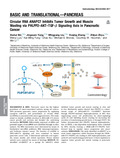
[en] [en] BACKGROUND & AIMS: Pancreatic cancer has the highest prevalence of cancer-associated cachexia among all cancers. ZIP4 promotes pancreatic cancer progression by regulating oncogenic miR-373, and perturbation of circular RNAs (circRNAs) is associated with cancer aggressiveness. This study aimed to identify circRNAs involved in ZIP4/miR-373-driven cancer growth and cachexia and decipher the underlying mechanism.
METHODS: Differentially expressed circRNAs and potential targets of microRNA were identified through in silico analysis. The RNA interactions were determined by means of biotinylated microRNA pulldown, RNA immunoprecipitation, and luciferase reporter assays. The function of circRNA in ZIP4-miR-373 signaling axis were examined in human pancreatic cancer cells, 3-dimensional spheroids and organoids, mouse models, and clinical specimens. Mouse skeletal muscles were analyzed by means of histology.
RESULTS: We identified circANAPC7 as a sponge for miR-373, which inhibited tumor growth and muscle wasting in vitro and in vivo. Mechanistic studies showed that PHLPP2 is a downstream target of ZIP4/miR-373. CircANAPC7 functions through PHLPP2-mediated dephosphorylation of AKT, thus suppressing cancer cell proliferation by down-regulating cyclin D1 and inhibiting muscle wasting via decreasing the secretion of transforming growth factor-β through STAT5. We further demonstrated that PHLPP2 induced dephosphorylation of CREB, a zinc-dependent transcription factor activated by ZIP4, thereby forming a CREB-miR-373-PHLPP2 feed-forward loop to regulate tumor progression and cancer cachexia.
CONCLUSION: This study identified circANAPC7 as a novel tumor suppressor, which functions through the CREB-miR-373-PHLPP2 axis, leading to AKT dephosphorylation, and cyclin D1 and transforming growth factor-β down-regulation to suppress tumor growth and muscle wasting in pancreatic cancer.
Disciplines :
Biochemistry, biophysics & molecular biology
Author, co-author :
Shi, Xiuhui ✱; Université de Liège - ULiège > Département de pharmacie ; Department of Medicine, University of Oklahoma Health Sciences Center, Oklahoma City, Oklahoma, Department of Surgery, University of Oklahoma Health Sciences Center, Oklahoma City, Oklahoma
Yang, Jingxuan ✱; Department of Medicine, University of Oklahoma Health Sciences Center, Oklahoma City, Oklahoma, Department of Surgery, University of Oklahoma Health Sciences Center, Oklahoma City, Oklahoma
Liu, Mingyang ✱; Department of Medicine, University of Oklahoma Health Sciences Center, Oklahoma City, Oklahoma, Department of Surgery, University of Oklahoma Health Sciences Center, Oklahoma City, Oklahoma
Zhang, Yuqing ✱; Department of Medicine, University of Oklahoma Health Sciences Center, Oklahoma City, Oklahoma, Department of Surgery, University of Oklahoma Health Sciences Center, Oklahoma City, Oklahoma
Zhou, Zhijun ✱; Department of Medicine, University of Oklahoma Health Sciences Center, Oklahoma City, Oklahoma, Department of Surgery, University of Oklahoma Health Sciences Center, Oklahoma City, Oklahoma
Luo, Wenyi; Department of Pathology, University of Oklahoma Health Sciences Center, Oklahoma City, Oklahoma
Fung, Kar-Ming; Department of Pathology, University of Oklahoma Health Sciences Center, Oklahoma City, Oklahoma
Xu, Chao; Department of Biostatistics and Epidemiology, Hudson College of Public Health, University of Oklahoma Health Sciences Center, Oklahoma City, Oklahoma
Bronze, Michael S; Department of Medicine, University of Oklahoma Health Sciences Center, Oklahoma City, Oklahoma
Houchen, Courtney W; Department of Medicine, University of Oklahoma Health Sciences Center, Oklahoma City, Oklahoma
Li, Min ; Department of Medicine, University of Oklahoma Health Sciences Center, Oklahoma City, Oklahoma, Department of Surgery, University of Oklahoma Health Sciences Center, Oklahoma City, Oklahoma. Electronic address: Min-Li@ouhsc.edu
✱ These authors have contributed equally to this work.
Language :
English
Title :
Circular RNA ANAPC7 Inhibits Tumor Growth and Muscle Wasting via PHLPP2-AKT-TGF-β Signaling Axis in Pancreatic Cancer.
William and Ella Owens Medical Research Foundation
Funding text :
Funding This work was supported in part by the William and Ella Owens Medical Research Foundation (Min Li), United States; Department of Medicine at University of Oklahoma Health Sciences Center, United States.
Siegel, R.L., Miller, K.D., Fuchs, H.E., et al. Cancer statistics, 2021. CA Cancer J Clin 71 (2021), 7–33.
Mizrahi, J.D., Surana, R., Valle, J.W., et al. Pancreatic cancer. Lancet 395 (2020), 2008–2020.
Baracos, V.E., Martin, L., Korc, M., et al. Cancer-associated cachexia. Nat Rev Dis Primers, 4, 2018, 17105.
Fearon, K., Strasser, F., Anker, S.D., et al. Definition and classification of cancer cachexia: an international consensus. Lancet Oncol 12 (2011), 489–495.
Petruzzelli, M., Wagner, E.F., Mechanisms of metabolic dysfunction in cancer-associated cachexia. Genes Dev 30 (2016), 489–501.
Bafaro, E., Liu, Y., Xu, Y., et al. The emerging role of zinc transporters in cellular homeostasis and cancer. Signal Transduct Target Ther, 2, 2017.
Yu, Z., Yu, Z., Chen, Z.B., et al. Zinc chelator TPEN induces pancreatic cancer cell death through causing oxidative stress and inhibiting cell autophagy. J Cell Physiol 234 (2019), 20648–20661.
Yang, J., Zhang, Y., Cui, X., et al. Gene profile identifies zinc transporters differentially expressed in normal human organs and human pancreatic cancer. Curr Mol Med 13 (2013), 401–409.
Li, M., Zhang, Y., Liu, Z., et al. Aberrant expression of zinc transporter ZIP4 (SLC39A4) significantly contributes to human pancreatic cancer pathogenesis and progression. Proc Natl Acad Sci U S A 104 (2007), 18636–18641.
Zhang, Y., Yang, J., Cui, X., et al. A novel epigenetic CREB-miR-373 axis mediates ZIP4-induced pancreatic cancer growth. EMBO Mol Med 5 (2013), 1322–1334.
Liu, M., Yang, J., Zhang, Y., et al. ZIP4 promotes pancreatic cancer progression by repressing ZO-1 and claudin-1 through a ZEB1-dependent transcriptional mechanism. Clin Cancer Res 24 (2018), 3186–3196.
Liu, M., Zhang, Y., Yang, J., et al. ZIP4 increases expression of transcription factor ZEB1 to promote integrin alpha3beta1 signaling and inhibit expression of the gemcitabine transporter ENT1 in pancreatic cancer cells. Gastroenterology 158 (2020), 679–692.e1.
Liu, M., Zhang, Y., Yang, J., et al. Zinc-dependent regulation of ZEB1 and YAP1 coactivation promotes epithelial-mesenchymal transition plasticity and metastasis in pancreatic cancer. Gastroenterology 160 (2021), 1771–1783.e1.
Yang, J., Zhang, Z., Zhang, Y., et al. ZIP4 promotes muscle wasting and cachexia in mice with orthotopic pancreatic tumors by stimulating RAB27B-regulated release of extracellular vesicles from cancer cells. Gastroenterology 156 (2019), 722–734.e6.
Kristensen, L.S., Andersen, M.S., Stagsted, L.V.W., et al. The biogenesis, biology and characterization of circular RNAs. Nat Rev Genet 20 (2019), 675–691.
Liu, H., Lei, C., He, Q., et al. Nuclear functions of mammalian MicroRNAs in gene regulation, immunity and cancer. Mol Cancer, 17, 2018, 64.
Zhong, Y.X., Du, Y.J., Yang, X., et al. Circular RNAs function as ceRNAs to regulate and control human cancer progression. Mol Cancer, 17, 2018.
Memczak, S., Jens, M., Elefsinioti, A., et al. Circular RNAs are a large class of animal RNAs with regulatory potency. Nature 495 (2013), 333–338.
Chen, J., Chen, T., Zhu, Y., et al. circPTN sponges miR-145-5p/miR-330-5p to promote proliferation and stemness in glioma. J Exp Clin Cancer Res, 38, 2019, 398.
Guo, X., Zhou, Q., Su, D., et al. Circular RNA circBFAR promotes the progression of pancreatic ductal adenocarcinoma via the miR-34b-5p/MET/Akt axis. Mol Cancer, 19, 2020, 83.
Zhang, P.F., Gao, C., Huang, X.Y., et al. Cancer cell-derived exosomal circUHRF1 induces natural killer cell exhaustion and may cause resistance to anti-PD1 therapy in hepatocellular carcinoma. Mol Cancer, 19, 2020, 110.
Shao, F., Huang, M., Meng, F., et al. Circular RNA signature predicts gemcitabine resistance of pancreatic ductal adenocarcinoma. Front Pharmacol, 9, 2018, 584.
Hong, O.Y., Mou, L.J., Luk, C., et al. Immortal human pancreatic duct epithelial cell lines with near normal genotype and phenotype. Am J Pathol 157 (2000), 1623–1631.
Lal, A., Thomas, M.P., Altschuler, G., et al. Capture of microRNA-bound mRNAs identifies the tumor suppressor miR-34a as a regulator of growth factor signaling. PLoS Genet, 7, 2011, e1002363.
Liu, M., Wang, Q., Shen, J., et al. Circbank: a comprehensive database for circRNA with standard nomenclature. RNA Biol 16 (2019), 899–905.
Li, H., Hao, X., Wang, H., et al. Circular RNA expression profile of pancreatic ductal adenocarcinoma revealed by microarray. Cell Physiol Biochem 40 (2016), 1334–1344.
Brognard, J., Sierecki, E., Gao, T., et al. PHLPP and a second isoform, PHLPP2, differentially attenuate the amplitude of Akt signaling by regulating distinct Akt isoforms. Mol Cell 25 (2007), 917–931.
Zhang, Y., Bharadwaj, U., Logsdon, C.D., et al. ZIP4 regulates pancreatic cancer cell growth by activating IL-6/STAT3 pathway through zinc finger transcription factor CREB. Clin Cancer Res 16 (2010), 1423–1430.
Wang, G., Biswas, A.K., Ma, W.C., et al. Metastatic cancers promote cachexia through ZIP14 upregulation in skeletal muscle. Nat Med 24 (2018), 770–781.
Yang, S., Wang, J., Brand, D.D., et al. Role of TNF-TNF receptor 2 signal in regulatory T cells and its therapeutic implications. Front Immunol, 9, 2018, 784.
Jones, N., Vincent, E.E., Cronin, J.G., et al. Akt and STAT5 mediate naive human CD4+ T-cell early metabolic response to TCR stimulation. Nat Commun, 10, 2019, 2042.
Zhang, Y.Q., Chen, C.Y., Yao, Q.Z., et al. ZIP4 upregulates the expression of neuropilin-1, vascular endothelial growth factor, and matrix metalloproteases in pancreatic cancer cell lines and xenografts. Cancer Biol Ther 9 (2010), 235–241.
Voorhoeve, P.M., le Sage, C., Schrier, M., et al. A genetic screen implicates miRNA-372 and miRNA-373 as oncogenes in testicular germ cell tumors. Cell 124 (2006), 1169–1181.
Zhang, Y., Zhang, X.O., Chen, T., et al. Circular intronic long noncoding RNAs. Mol Cell 51 (2013), 792–806.
Chen, L.L., The biogenesis and emerging roles of circular RNAs. Nat Rev Mol Cell Biol 17 (2016), 205–211.
Liu, J., Eckert, M.A., Harada, B.T., et al. m(6)A mRNA methylation regulates AKT activity to promote the proliferation and tumorigenicity of endometrial cancer. Nat Cell Biol 20 (2018), 1074–1083.
Nitsche, C., Edderkaoui, M., Moore, R.M., et al. The phosphatase PHLPP1 regulates Akt2, promotes pancreatic cancer cell death, and inhibits tumor formation. Gastroenterology 142 (2012), 377–387.e1–e5.
Yan, Y., Krecke, K.N., Bapat, A.S., et al. Phosphatase PHLPP2 regulates the cellular response to metabolic stress through AMPK. Cell Death Dis, 12, 2021, 904.
Zeng, Q., Liu, Y.M., Liu, J., et al. Inhibition of ZIP4 reverses epithelial-to-mesenchymal transition and enhances the radiosensitivity in human nasopharyngeal carcinoma cells. Cell Death Dis, 10, 2019, 588.
Fearon, K., Arends, J., Baracos, V., Understanding the mechanisms and treatment options in cancer cachexia. Nat Rev Clin Oncol 10 (2013), 90–99.
Poulia, K.A., Sarantis, P., Antoniadou, D., et al. Pancreatic cancer and cachexia-metabolic mechanisms and novel insights. Nutrients, 12, 2020.
Liu, Z., Sin, K.W.T., Ding, H., et al. p38beta MAPK mediates ULK1-dependent induction of autophagy in skeletal muscle of tumor-bearing mice. Cell Stress 2 (2018), 311–324.
Guttridge, D.C., A TGF-beta pathway associated with cancer cachexia. Nat Med 21 (2015), 1248–1249.
Zhang, H., Zhu, L., Bai, M., et al. Exosomal circRNA derived from gastric tumor promotes white adipose browning by targeting the miR-133/PRDM16 pathway. Int J Cancer 144 (2019), 2501–2515.
Ding, Z., Sun, D., Han, J., et al. Novel noncoding RNA CircPTK2 regulates lipolysis and adipogenesis in cachexia. Mol Metab, 53, 2021, 101310.
Greco, S.H., Tomkotter, L., Vahle, A.K., et al. TGF-beta blockade reduces mortality and metabolic changes in a validated murine model of pancreatic cancer cachexia. PLoS One, 10, 2015, e0132786.
Ritchie, M.E., Phipson, B., Wu, D., et al. limma powers differential expression analyses for RNA-sequencing and microarray studies. Nucleic Acids Res, 43, 2015, e47.