Abstract :
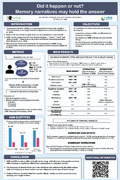
[en] A “nonbelieved memory” (NBM) refers to an autobiographical memory that is no longer believed to represent an event that actually occurred, despite a vivid recollection of the event. More precisely, belief in the occurrence of an event (i.e., autobiographical belief) can be either reduced or suppressed, without losing the ability to remember it (i.e., recollection). NBMs can be categorised into three distinct subtypes – “classic”, “weak” and “grain of doubt” – depending on the level of recollection and autobiographical belief. While previous studies have focused on the characteristics of NBMs and those of the people who have them, this study breaks new ground by examining how these memories are reported in comparison to classic autobiographical memories (i.e., BMs, for believed memories). Specifically, we wanted to investigate potential differences between the two types of memory, taking into account the three categories of NBM that can be reported and the type of belief change (reduced or suppressed). To do this, we re-analysed narratives from participants who had described both a NBM and a BM from the same period of life. The narratives were analysed using the LIWC software, which extracts standard linguistic markers and discursive markers related to psychological processes. In this study, we focused on self-referential, perceptual, contextual and cognitive features, as well as standard linguistic markers in the narratives. We also examined the influence of temporal variables – i.e., distance from event, distance from belief change, and belief duration – on both standard and discursive markers. The results showed that, regardless of the type of NBM reported by participants, NBM and BM narratives differed in terms of length, tenses used, self-referential and cognitive features, but not in terms of perceptual and contextual features. This suggests that changes in autobiographical belief are reflected in narrative content. We then observed that the narratives of NBMs with reduced belief contained more markers of doubt than those of NBMs with suppressed belief and BMs. This suggests that the persistence of even a small degree of belief (in NBM with reduced belief), as well as the absence of doubt when belief is clearly maintained (in BMs) or completely lost (in NBMs with suppressed belief), influences the way people talk about their memories. Finally, temporal variables appeared to have minimal effects on the frequency of linguistic and discursive markers.