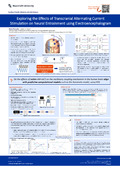
Background. Neural oscillations, representing dynamic brain activity, are crucial for various cognitive functions and are commonly observed via electroencephalogram recordings. Recent research has explored the modulation of these oscillations through transcranial alternating current stimulation. Neural entrainment entails aligning endogenous brain activity with external rhythmic stimuli like transcranial alternating current stimulation. Despite the established impacts of transcranial alternating current stimulation on cognitive and motor functions, the precise mechanism underlying its modulation of neural oscillations remains uncertain. Computational models provide a means to stimulate the anticipated effects of transcranial alternating current stimulation on oscillatory mechanisms based on the physical characteristics of the oscillator. Hence, this study aims to investigate whether the observed effects of transcranial alternating current stimulation on oscillatory coupling mechanisms in the human brain align with predictions from computational models, using electroencephalogram recordings.
Methods. Eleven healthy individuals (21±2.8 years old) were included in the study. Amplitude-modulated transcranial alternating current stimulation and electroencephalogram recordings were conducted simultaneously. Intermittent stimulation was administered over the left parietal lobe in a 4x4 design, varying intensity (0.4, 0.8, 1.2, and 1.6 mA) and frequency (2.5 and 1.5 Hz below and above the individual alpha frequency of each participant). Participants were asked not to perform any task during the experiment. Electroencephalogram post-stimulation data underwent frequency analysis and power spectral analysis. A repeated-measure ANOVA was also conducted to examine the interactions among the 16 conditions.
Results. The Greenhouse-Geisser test examining within-subject effects across the 16 conditions in data post-stimulation showed non-significant outcomes for both power and frequency variables, with p-values of 0.09 and 0.409, respectively. Similarly, the quadratic-linear contrast did not yield statistically significant results for either variable, with p-values of 0.964 for power and 0.892 for frequency. Despite the absence of statistically significant findings, notable patterns emerged from the plots depicting the interactions between the conditions. Specifically, it was observed that higher intensities and frequencies closer to intrinsic neural oscillations tend to result in enhanced alignment between endogenous neural oscillations and transcranial alternating current stimulation frequency. These observations suggest the potential for improved results with a larger sample size and by analysing data during the transcranial alternating current stimulation application.
Conclusion. Although the statistical analyses did not yield significant results, the emerging patterns from the data suggest great potential for future research to validate the effects of transcranial alternating current stimulation on the oscillatory coupling mechanism in the human brain.
Disciplines :
Neurology
Author, co-author :
Poncelet, Marie ; Université de Liège - ULiège > GIGA ; UHasselt - Hasselt University
ten Oever, Sanne; UM - University of Maastricht
Language :
English
Title :
Exploring the Effects of Transcranial Alternating Current Stimulation on Neural Entrainment using Electroencephalogram