Keywords :
Carboxylic acid dimers; Collision cross sections; Cross-section values; High resolution mass spectrometry; Ion mobility spectrometry; Negative electrospray ionizations; Perfluoroalkyl carboxylic acids; Polyfluoroalkyl substances; Pubchem; Structural characterization; Structural Biology; Spectroscopy
Abstract :
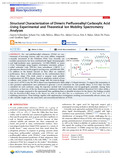
[en] Per- and polyfluoroalkyl substances (PFAS) are contaminants of increasing concern, with over seven million compounds currently inventoried in the PubChem PFAS Tree. Recently, ion mobility spectrometry has been combined with liquid chromatography and high-resolution mass spectrometry (LC-IMS-HRMS) to assess PFAS. Interestingly, using negative electrospray ionization, perfluoroalkyl carboxylic acids (PFCAs) form homodimers ([2M-H]-), a phenomenon observed with trapped, traveling wave, and drift-tube IMS. In addition to the limited research on their effect on analytical performance, there is little information on the conformations these dimers can adopt. This study aimed to propose most probable conformations for PFCA dimers. Based on qualitative analysis of how collision cross section (CCS) values change with the mass-to-charge ratio (m/z) of PFCA ions, the PFCA dimers were hypothesized to likely adopt a V-shaped structure. To support this assumption, in silico geometry optimizations were performed to generate a set of conformers for each possible dimer. A CCS value was then calculated for each conformer using the trajectory method with Lennard-Jones and ion-quadrupole potentials. Among these conformers, at least one of the ten lowest-energy conformers identified for each dimer exhibited theoretical CCS values within a ±2% error margin compared to the experimental data, qualifying them as plausible structures for the dimers. Our findings revealed that the fluorinated alkyl chains in the dimers are close to each other due to a combination of C-F···O=C and C-F···F-C stabilizing interactions. These findings, together with supplementary investigations involving environmentally relevant cations, may offer valuable insights into the interactions and environmental behavior of PFAS.
Funding text :
Computational resources for Gaussian calculations have been provided by the Consortium des E\u0301quipements de Calcul Intensif (CE\u0301CI), funded by the Fonds de la Recherche Scientifique de Belgique (F.R.S.-FNRS) under Grant No. 2.5020.11 and by the Walloon Region. A.S. also acknowledges financial support from the F.R.S.-FNRS (Research Fellow fellowship, 1.A.465.24F). L.B. acknowledges funding through a Research Foundation Flanders (FWO) fellowship (11G1821N). A.F and E.S.B. would also like to acknowledge funding from the NIH National Institute of Environmental Health Sciences (P42 ES027704) and a cooperative agreement with the Environmental Protection Agency (STAR RD 84003201). Analytical standards were purchased with funding from the Belgian Federal Public Service Health, Food Chain Safety and Environment, as part of the RT23/07 PFASFORWARD project.
Scopus citations®
without self-citations
4