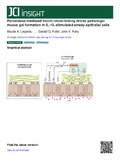
[en] Mucus plugs occlude airways to obstruct airflow in asthma. Studies in patients and in mouse models show that mucus plugs occur in the context of type 2 inflammation, and studies in human airway epithelial cells (HAECs) show that IL-13-activated cells generate pathologic mucus independently of immune cells. To determine how HAECs autonomously generate pathologic mucus, we used a magnetic microwire rheometer to characterize the viscoelastic properties of mucus secreted under varying conditions. We found that normal HAEC mucus exhibited viscoelastic liquid behavior and that mucus secreted by IL-13-activated HAECs exhibited solid-like behavior caused by mucin cross-linking. In addition, IL-13-activated HAECs shows increased peroxidase activity in apical secretions, and an overlaid thiolated polymer (thiomer) solution shows an increase in solid behavior that was prevented by peroxidase inhibition. Furthermore, gene expression for thyroid peroxidase (TPO), but not lactoperoxidase (LPO), was increased in IL-13-activated HAECs and both TPO and LPO catalyze the formation of oxidant acids that cross-link thiomer solutions. Finally, gene expression for TPO in airway epithelial brushings was increased in patients with asthma with high airway mucus plug scores. Together, our results show that IL-13-activated HAECs autonomously generated pathologic mucus via peroxidase-mediated cross-linking of mucin polymers.
Disciplines :
Immunology & infectious disease
Author, co-author :
Liégeois, Maude ; Université de Liège - ULiège > Département des sciences fonctionnelles (DSF) > Biochimie et biologie moléculaire ; Cardiovascular Research Institute, University of California, San Francisco, San Francisco, California, USA
Braunreuther, Margaret; Department of Chemical Engineering, Stanford University, Stanford, California, USA
Charbit, Annabelle R; Cardiovascular Research Institute, University of California, San Francisco, San Francisco, California, USA
Raymond, Wilfred W; Cardiovascular Research Institute, University of California, San Francisco, San Francisco, California, USA
Tang, Monica; Division of Pulmonary, Critical Care, Allergy and Sleep Medicine, UCSF, San Francisco, California, USA
Woodruff, Prescott G ; Cardiovascular Research Institute, University of California, San Francisco, San Francisco, California, USA ; Division of Pulmonary, Critical Care, Allergy and Sleep Medicine, UCSF, San Francisco, California, USA
Christenson, Stephanie A ; Division of Pulmonary, Critical Care, Allergy and Sleep Medicine, UCSF, San Francisco, California, USA
Castro, Mario; Division of Pulmonary, Critical Care, and Sleep Medicine, University of Kansas School of Medicine, Kansas City, Kansas, USA
Erzurum, Serpil C; Department of Pathobiology, Lerner Research Institute, Cleveland Clinic, Cleveland, Ohio, USA
Israel, Elliot; Division of Pulmonary and Critical Care Medicine, Department of Medicine, Brigham and Women's Hospital, Boston, Massachusetts, USA
Jarjour, Nizar N; Division of Allergy, Pulmonary, and Critical Care Medicine, University of Wisconsin School of Medicine and Public Health, Madison, Wisconsin, USA
Levy, Bruce D ; Division of Pulmonary and Critical Care Medicine, Department of Medicine, Brigham and Women's Hospital, Boston, Massachusetts, USA
Moore, Wendy C; Department of Internal Medicine, Section of Pulmonary, Critical Care, Allergy and Immunologic Diseases, Wake Forest School of Medicine, Winston-Salem, North Carolina, USA
Wenzel, Sally E ; Department of Environmental and Occupational Health, University of Pittsburgh, Pittsburgh, Pennsylvania, USA
Fuller, Gerald G; Department of Chemical Engineering, Stanford University, Stanford, California, USA
Fahy, John V; Cardiovascular Research Institute, University of California, San Francisco, San Francisco, California, USA ; Division of Pulmonary, Critical Care, Allergy and Sleep Medicine, UCSF, San Francisco, California, USA
NSF - National Science Foundation NIAID - National Institute of Allergy and Infectious Diseases NHLBI - National Heart Lung and Blood Institute
Funding text :
The authors thank Erin Gordon (UCSF) for providing human airway (tracheal) epithelial cells and the UCSF Genomic CoLab for their assistance with the sequencing data. The authors acknowledge Manuel Vazquez Villabeitia at the Institute of Material Science of Madrid, Spanish National Research Council (CSIC) for providing magnetic microwires. Javier Tajuelo is acknowledged for technical support of magnetic microwire procedures. The authors would like to thank the SARP clinical coordinators and laboratory personnel for their contribution to fulfilling SARP\u2019s scientific mission. The research findings resulting from SARP would not have been possible without their dedication and assistance with study visits, data collection, and biological sample processing. This work is supported in part by grants from the NIH National Heart Lung and Blood Institute grants (HL080414, HL107202, and AI077439). MB is supported by the Cystic Fibrosis Trust and the National Science Foundation Graduate Research Fellowship (NSF GRFP). The purchase of the Nikon SoRa microscope was funded by the NIH shared equipment grant S10OD028611-0.
Aegerter H, Lambrecht BN. The pathology of asthma: what is obstructing our view? Annu Rev Pathol. 2023;18:387–409.
Kuyper LM, et al. Characterization of airway plugging in fatal asthma. Am J Med. 2003;115(1):6–11.
Dunican EM, et al. Autopsy and imaging studies of mucus in asthma. Lessons learned about disease mechanisms and the role of mucus in airflow obstruction. Ann Am Thorac Soc. 2018;15(suppl 3):S184–S191.
Dunican EM, et al. Mucus plugs in patients with asthma linked to eosinophilia and airflow obstruction. J Clin Invest. 2018;128(3):997–1009.
Tang M, et al. Mucus plugs persist in asthma, and changes in mucus plugs associate with changes in airflow over time. Am J Respir Crit Care Med. 2022;205(9):1036–1045.
Innes AL, et al. Ex vivo sputum analysis reveals impairment of protease-dependent mucus degradation by plasma proteins in acute asthma. Am J Respir Crit Care Med. 2009;180(3):203–210.
Zhu Z, et al. Pulmonary expression of interleukin-13 causes inflammation, mucus hypersecretion, subepithelial fibrosis, physiologic abnormalities, and eotaxin production. J Clin Invest. 1999;103(6):779–788.
Bonser LR, et al. Epithelial tethering of MUC5AC-rich mucus impairs mucociliary transport in asthma. J Clin Invest. 2016;126(6):2367–2371.
Braunreuther M, et al. Nondestructive rheological measurements of biomaterials with a magnetic microwire rheometer. J Rheol (N Y N Y). 2023;67(2):579–588.
Jeffrey DJ, Onishi Y. The slow motion of a cylinder next to a plane wall. Q J Mech Appl Math. 1981;34(2):129–137.
Jackson ND, et al. Single-cell and population transcriptomics reveal pan-epithelial remodeling in type 2-high asthma. Cell Rep. 2020;32(1):107872.
Voraphani N, et al. An airway epithelial iNOS-DUOX2-thyroid peroxidase metabolome drives Th1/Th2 nitrative stress in human severe asthma. Mucosal Immunol. 2014;7(5):1175–1185.
Gerson C, et al. The lactoperoxidase system functions in bacterial clearance of airways. Am J Respir Cell Mol Biol. 2000;22(6):665–671.
Carvalho DP, Dupuy C. Thyroid hormone biosynthesis and release. Mol Cell Endocrinol. 2017;458:6–15.
Teague WG, et al. Baseline features of the severe asthma research program (SARP III) cohort: differences with age. J Allergy Clin Immunol Pract. 2018;6(2):545–554.
Kasela S, et al. Genetic and non-genetic factors affecting the expression of COVID-19-relevant genes in the large airway epithelium. Genome Med. 2021;13(1):66.
Crick FHC. The physical properties of cytoplasm. A study by means of the magnetic particle method. Part II. Theoretical treatment. Exp Cell Res. 1950;1(4):505–533.
Sato M, et al. Rheological properties of living cytoplasm: a preliminary investigation of squid axoplasm (Loligo pealei). Cell Motil. 1984;4(1):7–23.
Bausch AR, et al. Measurement of local viscoelasticity and forces in living cells by magnetic tweezers. Biophys J. 1999;76(1 pt 1):573–579.
Ziemann F, et al. Local measurements of viscoelastic moduli of entangled actin networks using an oscillating magnetic bead micro-rheometer. Biophys J. 1994;66(6):2210–2216.
Wong IY, et al. Anomalous diffusion probes microstructure dynamics of entangled F-actin networks. Phys Rev Lett. 2004;92(17):178101.
Bausch AR, et al. Local measurements of viscoelastic parameters of adherent cell surfaces by magnetic bead microrheometry. Biophys J. 1998;75(4):2038–2049.
Bausch AR, et al. Rapid stiffening of integrin receptor-actin linkages in endothelial cells stimulated with thrombin: a magnetic bead microrheology study. Biophys J. 2001;80(6):2649–2657.
Lambrecht BN, et al. The cytokines of asthma. Immunity. 2019;50(4):975–991.
Wills-Karp M, et al. Interleukin-13: central mediator of allergic asthma. Science. 1998;282(5397):2258–2261.
Carpenter J, et al. Assembly and organization of the N-terminal region of mucin MUC5AC: indications for structural and functional distinction from MUC5B. Proc Natl Acad Sci U S A. 2021;118(39):e2104490118.
Tanabe T, et al. Modulation of mucus production by interleukin-13 receptor alpha2 in the human airway epithelium. Clin Exp Allergy. 2008;38(1):122–134.
Thornton DJ, et al. Structure and function of the polymeric mucins in airways mucus. Annu Rev Physiol. 2008;70:459–486.
Forteza R, et al. Regulated hydrogen peroxide production by Duox in human airway epithelial cells. Am J Respir Cell Mol Biol. 2005;32(5):462–469.
Zhert G, et al. IL-13 and epidermal growth factor receptor have critical but distinct roles in epithelial cell mucin production. Am J Respir Cell Mol Biol. 2012;36(2):244–253.
Yamaya M, et al. Differentiated structure and function of cultures from human tracheal epithelium. Am J Physiol. 1992;262(6 pt 1):L713–L724.
Everman JL, et al. Utilization of air-liquid interface cultures as an in vitro model to assess primary airway epithelial cell responses to the type 2 cytokine interleukin-13. Methods Mol Biol. 2018;1799:419–432.
Bernkop-Schnürch A, et al. Polymers with thiol groups: a new generation of mucoadhesive polymers? Pharm Res. 1999;16(6):876–881.
Tajuelo J, et al. Magnetic microwire probes for the magnetic rod interfacial stress rheometer. Langmuir. 2015;31(4):1410–1420.
Nijenhuis K, et al. Non-Newtonian nano-fluids in Blasius and Sakiadis flows influenced by magnetic field. Nanomaterials (Basel). 2007;12(23):4254.
Hunt AJ, et al. The force exerted by a single kinesin molecule against a viscous load. Biophys J. 1994;67(2):766–781.