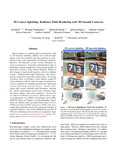
[en] Recent advances in radiance field reconstruction, such as 3D Gaussian Splatting (3DGS), have achieved high-quality novel view synthesis and fast rendering by representing scenes with compositions of Gaussian primitives. However, 3D Gaussians present several limitations for scene reconstruction. Accurately capturing hard edges is challenging without significantly increasing the number of Gaussians, creating a large memory footprint. Moreover, they struggle to represent flat surfaces, as they are diffused in space. Without hand-crafted regularizers, they tend to disperse irregularly around the actual surface. To circumvent these issues, we introduce a novel method, named 3D Convex Splatting (3DCS), which leverages 3D smooth convexes as primitives for modeling geometrically-meaningful radiance fields from multi-view images. Smooth convex shapes offer greater flexibility than Gaussians, allowing for a better representation of 3D scenes with hard edges and dense volumes using fewer primitives. Powered by our efficient CUDA-based rasterizer, 3DCS achieves superior performance over 3DGS on benchmarks such as Mip-NeRF360, Tanks and Temples, and Deep Blending. Specifically, our method attains an improvement of up to 0.81 in PSNR and 0.026 in LPIPS compared to 3DGS while maintaining high rendering speeds and reducing the number of required primitives. Our results highlight the potential of 3D Convex Splatting to become the new standard for
high-quality scene reconstruction and novel view synthesis. Project page:
convexsplatting.github.io.
Research Center/Unit :
Montefiore Institute - Montefiore Institute of Electrical Engineering and Computer Science - ULiège VIULab TELIM
Disciplines :
Computer science
Author, co-author :
Held, Jan ✱; Université de Liège - ULiège > Montefiore Institute of Electrical Engineering and Computer Science
Vandeghen, Renaud ✱; Université de Liège - ULiège > Montefiore Institute of Electrical Engineering and Computer Science
Cioppa, Anthony ; Université de Liège - ULiège > Montefiore Institute of Electrical Engineering and Computer Science
Giancola, Silvio
Vedaldi, Andrea
Ghanem, Bernard
Van Droogenbroeck, Marc ; Université de Liège - ULiège > Département d'électricité, électronique et informatique (Institut Montefiore) > Télécommunications
✱ These authors have contributed equally to this work.
Language :
English
Title :
3D Convex Splatting: Radiance Field Rendering with 3D Smooth Convexes
Publication date :
13 August 2025
Event name :
IEEE/CVF Conference on Computer Vision and Pattern Recognition (CVPR)
F.R.S.-FNRS - Fund for Scientific Research Walloon region
Funding number :
1910247
Funding text :
J. Held, A. Deliege and A. Cioppa are funded by the F.R.S.-FNRS. The research reported in this publication was supported by funding from KAUST Center of Excellence on GenAI, under award number 5940. This work was also supported by KAUST Ibn Rushd Postdoc Fellowship program. The present research benefited from computational resources made available on Lucia, the Tier-1 supercomputer of the Walloon Region, infrastructure funded by the Walloon Region under the grant agreement n°1910247.