DFT; ab initio; phonons; spectroscopy; vibrations; raman; machine learning
Abstract :
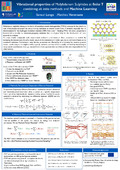
[en] Transition metal chalcogenides represent a topical family of materials as they hold promise in the field of energy generation and storage. Catalytic activity for the hydrogen evolution reaction (HER) is one of the most exciting properties of molybdenum sulfides, which opened to an intense research effort. This project focuses on the theoretical study of their vibrational behaviour, especially their infrared and Raman modes, in order to find the structure-property relations that can help to better understand the catalytic mechanisms. The state-of-the-art methods to address such study are based on DFT, whose implementation can be computationally expensive, especially when working at finite temperature. To overcome this difficulty, we resort to machine learning (ML). In particular, we use the ML-Assisted Canonical Sampling approach (MLACS), which exploits molecular dynamics to explore phase space and optimize the ML parameters for a model to compute the energy and forces for a given system. This Machine Learning Interatomic Potential can replace the DFT potential in the calculation of vibrational spectroscopy or transport.
Disciplines :
Physics
Author, co-author :
Longo, Samuel ; Université de Liège - ULiège > Complex and Entangled Systems from Atoms to Materials (CESAM)
Verstraete, Matthieu ; Université de Liège - ULiège > Département de physique > Physique des matériaux et nanostructures ; Université de Liège - ULiège > Complex and Entangled Systems from Atoms to Materials (CESAM)
Language :
English
Title :
Vibrational properties of Molybdenum Sulphides at finite T combining ab initio methods and Machine Learning
Publication date :
30 October 2023
Number of pages :
1
Event name :
Blending the DFT-Based Multiple Scattering Greens’ Function Approach to Spectroscopies with Machine Learning
Event organizer :
EuSpecLab
Event place :
Les Houches, France
Event date :
30/10/2023-12/11/2023
Audience :
International
European Projects :
HE - 101073486 - EUSpecLab - European Spectroscopy Laboratory to model the materials of the future