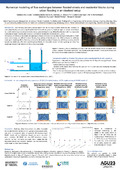
[en] Flooding in urban areas can pose a serious threat to human lives and have detrimental effects on the economic activity. Therefore, the accurate prediction of flow velocities and depths in urban areas during flooding is of paramount importance for flood risk assessment and for the development of evacuation routes. However, due to the complexity of the urban layout, these flow variables exhibit a wide variability, and their prediction is not trivial. While there has been significant progress in the modelling of urban flooding, the residential blocks within an urban area have been typically considered as impervious blocks. However, such residential blocks are usually characterized by openings, such as alleys leading to backyards and/or doors and windows that may break during an urban flood, which lead to flow exchanges between the flooded streets and the interior of the residential blocks. These flow exchanges can significantly influence the flow patterns around the block (Mejia-Morales et al., 2021). Dewals et al. (2023) modelled such flow exchanges based on the idealized laboratory setup of Mejia-Morales et al. (2021) and showed that 2D depth-averaged numerical models can model some cases well, but the modelling accuracy can be improved in the more complicated setups. This study extends the study of Dewals et al. (2023) by modelling the flow exchanges between a residential block with openings and the surrounding streets with 3D numerical models to identify what is the tradeoff between simple and fast, but less accurate, 2D depth-averaged models and detailed but computationally demanding 3D models. In addition, it is investigated whether models solving the 3D Reynolds averaged Navier Stokes equations perform adequately well or there is a need to use more detailed numerical models. Both steady and unsteady flow conditions are investigated.
References:
Dewals B., Kitsikoudis V., Mejía-Morales M. A., Archambeau P., Mignot E., Proust S., Erpicum S., Pirotton M., Paquier A. (2023). Can the 2D shallow water equations model flow intrusion into buildings during urban floods? Journal of Hydrology, 619, 129231.
Mejía-Morales M. A., Mignot E., Paquier A., Sigaud D., Proust S., (2021). Impact of the porosity of an urban block on the flood risk assessment: A laboratory experiment. Journal of Hydrology, 602, 126715.
Research Center/Unit :
UEE - Urban and Environmental Engineering - ULiège
Disciplines :
Civil engineering
Author, co-author :
Kitsikoudis, Vasileios; Water Engineering and Management, University of Twente, Enschede, The Netherland
Li, Xuefang; College of Civil Engineering and Architecture, Guangxi University, Nanning, China
Yu, Shuyue; College of Civil Engineering and Architecture, Guangxi University, Nanning, China
Dellinger, Guilhem; ICube Laboratory, National School for Water and Environmental Engineering, Strasbourg, France
Archambeau, Pierre ; Université de Liège - ULiège > Département ArGEnCo > HECE (Hydraulics in Environnemental and Civil Engineering)
Erpicum, Sébastien ; Université de Liège - ULiège > Urban and Environmental Engineering
Pirotton, Michel ; Université de Liège - ULiège > Département ArGEnCo > HECE (Hydraulics in Environnemental and Civil Engineering)
Dewals, Benjamin ; Université de Liège - ULiège > Département ArGEnCo > Hydraulics in Environmental and Civil Engineering
Language :
English
Title :
Numerical modelling of flow exchanges between flooded streets and residential blocks during urban flooding in an idealized setup