Keywords :
CP: Neuroscience; FDG-PET; brain injury; disorders of consciousness; electroencephalography; electrometabolic coupling; mesocircuit hypothesis; minimally conscious state; multimodal neuroimaging; structural MRI; Biochemistry, Genetics and Molecular Biology (all); General Biochemistry, Genetics and Molecular Biology
Abstract :
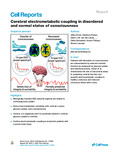
[en] We assess cerebral integrity with cortical and subcortical FDG-PET and cortical electroencephalography (EEG) within the mesocircuit model framework in patients with disorders of consciousness (DoCs). The mesocircuit hypothesis proposes that subcortical activation facilitates cortical function. We find that the metabolic balance of subcortical mesocircuit areas is informative for diagnosis and is associated with four EEG-based power spectral density patterns, cortical metabolism, and α power in healthy controls and patients with a DoC. Last, regional electrometabolic coupling at the cortical level can be identified in the θ and α ranges, showing positive and negative relations with glucose uptake, respectively. This relation is inverted in patients with a DoC, potentially related to altered orchestration of neural activity, and may underlie suboptimal excitability states in patients with a DoC. By understanding the neurobiological basis of the pathophysiology underlying DoCs, we foresee translational value for diagnosis and treatment of patients with a DoC.
Funding text :
We are thankful to the patients and their families for their participation. The authors thank the entire staff from the Center du Cerveau 2 , Radiodiagnostic and Nuclear Medicine departments, University Hospital of Liege. A.S. is postdoctoral fellow, O.G. and A.T. are research associates, and S.L. is research director at F.R.S.-FNRS . S.L. received funding from the European Union’s Horizon 2020 Framework Programme for Research and Innovation under the Specific Grant Agreement No. 945539 (Human Brain Project SGA3). The study was further supported by the University and University Hospital of Liege and the European Commission .We are thankful to the patients and their families for their participation. The authors thank the entire staff from the Center du Cerveau2, Radiodiagnostic and Nuclear Medicine departments, University Hospital of Liege. A.S. is postdoctoral fellow, O.G. and A.T. are research associates, and S.L. is research director at F.R.S.-FNRS. S.L. received funding from the European Union's Horizon 2020 Framework Programme for Research and Innovation under the Specific Grant Agreement No. 945539 (Human Brain Project SGA3). The study was further supported by the University and University Hospital of Liege and the European Commission. Conceptualization, J.A. and S.L.; data acquisition, J.A. O.G. A.T. E.A.C.B. and M.M.V.; design, data curation, validation, and visualization, J.A. and G.F.; formal analysis, J.A. G.F. G.J.M.v.d.L. C.C. N.D.S. and R.P.; coding, J.A. G.F. F.R. M.A.B. and R.P.; writing – original draft, J.A.; writing – review & editing, J.A. G.F. A.T. O.G. A.S. G.J.M.v.d.L. C.C. E.A.C.B. M.M.V. N.D.S. and S.L.; funding acquisition, S.L. O.G. and A.T.; supervision, S.L. The authors declare no competing interests. We support inclusive, diverse, and equitable conduct of research.
Scopus citations®
without self-citations
13