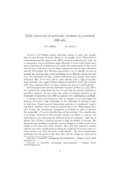
[en] Rate of success in the first year at University in Belgium is very low regarding other foreign universities. The University of Liege, as other Universities, has already taken different initiatives.
But by early identifying students who have a high probability to face difficulties if nothing is done, the Universities might develop adapted methods to attack the problem with more emphasis where it is more needed and when it is still possible.
Thus we want to develop a decision tool able to identify these students to help them. For that, we consider three standard datamining methods: logistic regression, artificial neural networks and decision trees and focus on early detection, i.e. before starting at the University.
Then, we suggest to adapt these three methods as well as the classification framework in order to increase the probability of correct identification of the students. In our approach, we do not restrict the classification to two extreme classes, e.g. failure or success, but we create subcategories for different levels of confidence: high risk of failure, risk of failure, expected success or high probability of success. The algorithms are modified accordingly and to give more weight to the class that really matters.
Note that this approach remains valid for any other classification problems for which the focus is on some extreme classes; e.g. fraud detection, credit default...
Finally, simulations are conducted to measure the performances of the three methods, with and without the suggested adaptation. We check if the factors of success/failure we can identify are similar to those reported in the literature.
We also make a ``what-if sensitivity analysis''. The goal is to measure in more depth the impact of some factors and the impact of some solutions, e.g., a complementary training or a reorientation.
Disciplines :
Quantitative methods in economics & management
Author, co-author :
Hoffait, Anne-Sophie ; Université de Liège - ULiège > HEC-Ecole de gestion : UER > Mathématiques pour les sciences économiques et de gestion
Schyns, Michael ; Université de Liège - ULiège > HEC-Ecole de gestion : UER > UER Opérations : Informatique de gestion
Language :
English
Title :
Early detection of university students in potential difficulty
Publication date :
February 2015
Number of pages :
2
Event name :
16e conférence de la Roadef (Société Française de Recherche Opérationelle et Aide à la Décision)